
Finding cheapest health insurance for your family in Texas can feel like searching for a needle in a haystack. With so many options, confusing terms, and price tags that make your eyes water, it’s easy to get frustrated.
But here’s the good news. 2026 brings some new options and opportunities for Texas families to get covered without breaking the bank. Whether you’re a family of four in Houston, a couple with a new baby in San Antonio, or a single parent in Dallas, there are affordable plans out there.
I’ve done the digging for you. Let’s walk through the cheapest health insurance options for Texas families this year, how to qualify for savings, and exactly what you need to know before you enroll.
Why Texas Families Need Health Insurance Now More Than Ever
Let’s be honest. Medical bills are the number one cause of bankruptcy in America. One emergency room visit, one unexpected surgery, or one chronic condition diagnosis can wipe out years of savings.
Texas has one of the highest uninsured rates in the country. About 17% of Texans don’t have health coverage. That’s nearly 5 million people. If your family is part of that number, you’re gambling with your financial future.
The Affordable Care Act (ACA) marketplace, also known as Healthcare.gov, is where most families find affordable coverage. But here’s what’s changed for 2026. More insurers are offering plans, premiums have stabilized in many areas, and new subsidy rules mean more families qualify for help .
The Best Cheap Health Insurance Options for Texas Families in 2026
After comparing rates, coverage, and family-friendly features, here are the top contenders for affordable family health insurance in Texas this year.
1. Ambetter from Superior HealthPlan: Best for Budget-Conscious Families
Ambetter has been a major player in Texas for years, and for 2026, they’re offering some of the most affordable plans across 150 counties in the state .
Why it’s a top pick:
Ambetter offers multiple plan levels so you can choose what fits your budget. Their Ambetter Health Value plans are designed specifically for families who want lower monthly payments. These plans use a network of specific healthcare providers and hospitals to keep costs down .
The family-friendly perks:
- My Health Pays rewards program: This is actually pretty cool. Family members can earn points for healthy activities like exercising, completing health surveys, or getting preventive care. You can earn up to $500 in rewards for 2026, which can be used toward premiums, copays, or deductibles .
- Condition-specific plans: If someone in your family has diabetes, Ambetter offers Enhanced Diabetes Care Silver plans with $0 copays for preferred insulin and select medications. They also cover diabetic supplies like test strips and lancets at no cost .
- Virtual 24/7 Care: Got a sick kid at 10 PM? You can talk to a licensed provider from home for common issues like fever, flu, or ear infections . For Know about car insurance click here
Where it’s available:
Ambetter serves 150 counties across Texas. Check their website to see if your county qualifies .
2. Oscar Health: Best for Tech-Savvy Families
Oscar has expanded significantly in Texas for 2026. They’re now offering plans in San Antonio, Dallas/Fort Worth, and El Paso .
Why it’s a top pick:
Oscar is known for making health insurance easy to use. Their website and app are intuitive, and they offer features you won’t find elsewhere. More than 3 in 5 members recommend Oscar to friends and family .
The family-friendly perks:
- $0 virtual urgent care and primary care: For many plans, you can see a doctor online 24/7 at no cost. This is huge for families with busy schedules .
- Oscar Care Guides: You get three dedicated guides to help navigate the healthcare system. Think of them as personal assistants for your family’s health needs .
- Guided Care HMO: This new product offers lower premiums while using technology to connect you with primary care doctors and specialists quickly .
- Condition-focused plans: If family members have diabetes, asthma, COPD, or heart conditions, Oscar offers specialized plans with $0 costs for relevant care. That means $0 inhalers, $0 insulin, $0 specialist visits for those conditions .
Where it’s available:
- San Antonio area: Atascosa, Bandera, Bexar, Comal, Guadalupe, Kendall, Medina, and Wilson counties
- Dallas/Fort Worth area: Collin, Cooke, Dallas, Denton, Ellis, Parker, Rockwall, Tarrant, and Wise counties
- El Paso area: El Paso and Hudspeth counties
3. Blue Cross and Blue Shield of Texas: Best for Broad Provider Networks
BCBSTX is a household name in Texas, and for good reason. They offer plans across the entire state with networks that include most major hospitals and doctors.
Why it’s a top pick:
If keeping your current doctors is important, BCBSTX is probably your best bet. Their massive network means you’re more likely to find covered providers close to home.
The family-friendly perks:
- Multiple metal levels: BCBSTX offers Bronze, Silver, and Gold plans so you can pick the right balance of monthly premium vs. out-of-pocket costs .
- Gold plans for heavy users: If your family has chronic conditions, multiple prescriptions, or you’re planning a pregnancy, Gold plans cover about 80% of your healthcare costs. Deductibles start as low as $500 .
- Silver plans for balance: These offer $0 deductibles starting point, with 30% coinsurance after that .
- Bronze for tight budgets: If your family is generally healthy, Bronze plans have lower monthly payments. Deductibles start around $4,500 .
4. Aetna: Strong HDHP Options for HSA Savers
Aetna offers several plans in Texas, including High Deductible Health Plans (HDHPs) that work with Health Savings Accounts (HSAs).
Why it’s a top pick:
If your family is healthy and you want to save money in a tax-advantaged account, Aetna’s HDHPs are worth a look. The 2026 plans include the Aetna HealthFund HDHP with biweekly premiums and HSA contributions .
The family-friendly perks:
- HSA compatibility: You can contribute pre-tax money to an HSA, which rolls over year after year. It’s like a savings account just for medical expenses.
- Preventive care covered before deductible: All HDHPs cover preventive services at 100% before you meet your deductible.
Plan details for 2026:
For the Aetna HealthFund HDHP in Texas:
- Self-only deductible: $1,800
- Family deductible: $3,600
- Medical account contribution: $800 for self, $1,600 for family
- Net deductible after contribution: $1,000 for self, $2,000 for family
5. GEHA: Strong National Option for Federal Employees and Families
If someone in your family is a federal employee or retiree, GEHA offers competitive HDHP options for 2026.
Why it’s a top pick:
GEHA’s HDHP plan includes significant HSA contributions that lower your net out-of-pocket costs .
Plan details for 2026:
- Self-only deductible: $1,800
- Family deductible: $3,600
- Medical account contribution: $1,000 for self, $2,000 for family
- Net deductible: $800 for self, $1,600 for family
- Annual out-of-pocket maximum: $6,000 self, $12,000 family
6. MHBP: Consumer Option with Strong HSA Support
The Mail Handlers Benefit Plan (MHBP) offers a Consumer Option HDHP that’s available to federal employees and their families .
Plan details for 2026:
- Self-only deductible: $2,000
- Family deductible: $4,000
- Medical account contribution: $1,200 for self, $2,400 for family
- Net deductible: $800 for self, $1,600 for family
- Annual out-of-pocket maximum: $6,500 self, $13,000 family
Quick Comparison Table: Affordable Health Insurance in Texas for 2026
How to Get the Cheapest Health Insurance in Texas
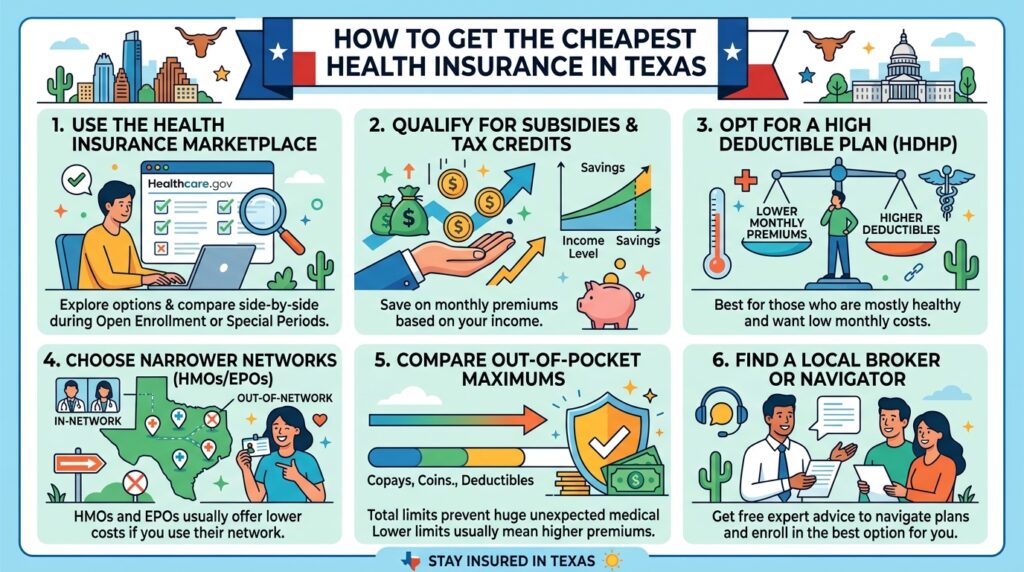
Finding affordable health insurance isn’t just about picking the right company. It’s about using every tool available to lower your costs. Here’s how.
1. Use Healthcare.gov and Check for Subsidies
This is the most important step. Go to Healthcare.gov and create an account. The system will ask about your income and family size. Based on that, you’ll see if you qualify for premium tax credits.
These credits lower your monthly payment. Sometimes by a lot. Many families qualify without even realizing it. For 2026, the rules are still favorable thanks to enhanced subsidies from the American Rescue Plan .
2. Consider Cost-Sharing Reductions (CSRs)
If your income is below 250% of the federal poverty level, you might qualify for CSRs when you buy a Silver plan. These reduce your out-of-pocket costs like deductibles and copays.
For example, a Silver plan with CSRs might have a much lower deductible than a standard Silver plan. You pay the same monthly premium but get better coverage when you need care .
3. Pick the Right Metal Level
The metal levels (Bronze, Silver, Gold, Platinum) aren’t about quality. They’re about cost structure.
- Bronze plans: Lowest monthly premium, highest costs when you need care. Good for healthy families who rarely see doctors.
- Silver plans: Moderate monthly premium, moderate costs when you need care. Good balance for most families.
- Gold plans: Higher monthly premium, lower costs when you need care. Good if you have chronic conditions, regular prescriptions, or planned pregnancies .
4. Use In-Network Providers
This sounds obvious, but it’s worth repeating. Going out of network can cost you thousands. Before you schedule any care, check that the provider is in your plan’s network.
If you have a favorite doctor or hospital, check their website or call them to see which insurance plans they accept. Then focus your search on those plans .
5. Consider an HDHP with an HSA
If your family is generally healthy, a High Deductible Health Plan paired with a Health Savings Account can save you money.
Here’s why:
- Lower monthly premiums
- HSA contributions are tax-deductible
- Money grows tax-free
- Withdrawals for medical expenses are tax-free
- Funds roll over year after year
For 2026, plans like Aetna’s HDHP and GEHA’s HDHP offer strong HSA contributions that offset the higher deductible .
6. Check If You Qualify for Special Programs
Texas offers several programs that might help your family get affordable health insurance:
- CHIP (Children’s Health Insurance Program): For families who earn too much for Medicaid but still need help covering kids.
- Medicaid: For very low-income families. Texas expanded Medicaid eligibility for children, but not for adults.
- Employer coverage: If you have a job with health benefits, compare that to marketplace plans. Sometimes employer coverage is cheaper, sometimes marketplace plans win.
What to Look for in a Family Health Insurance Plan
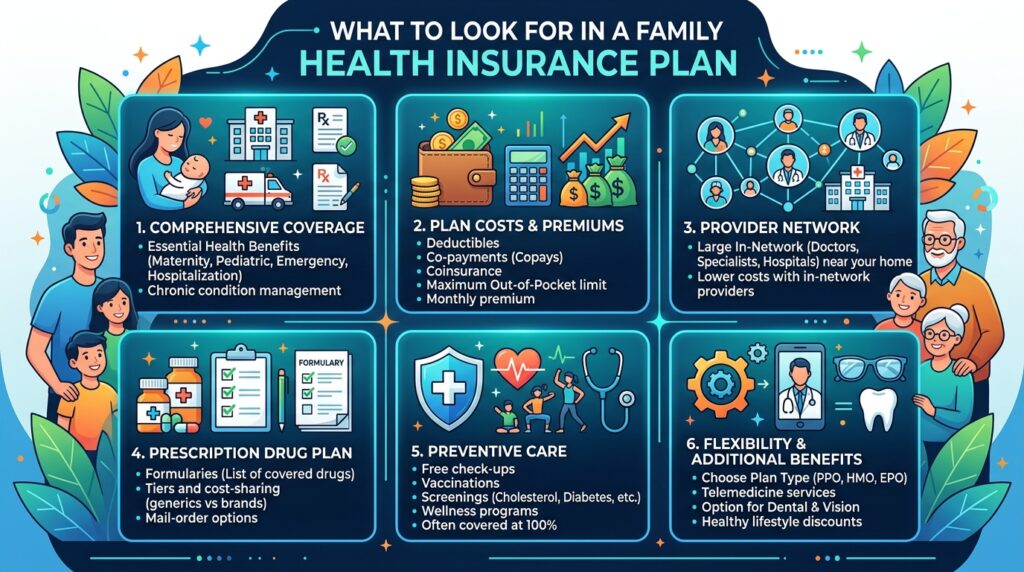
When you’re comparing plans, don’t just look at the monthly premium. Here’s what matters for families.
Deductible
This is what you pay before insurance starts sharing costs. A family deductible means you have to meet that amount before coverage kicks in for anyone. Some plans have embedded deductibles, meaning each family member has their own deductible. That’s usually better for families.
Out-of-Pocket Maximum
This is your financial safety net. Once you spend this much on covered care, the plan pays 100%. For 2026, the federal limit is around $9,450 for individuals and $18,900 for families, but many plans set lower limits .
Prescription Drug Coverage
If anyone in your family takes regular medications, check the formulary. Make sure their drugs are covered and at a reasonable tier. Some plans offer $0 generics or $0 insulin .
Pediatric Coverage
All marketplace plans cover pediatric services, including dental and vision. But coverage levels vary. If your kids need braces or glasses, check the details .
Maternity Care
If you’re planning to expand your family, look for plans with good maternity coverage. All marketplace plans cover pregnancy and childbirth, but costs vary. Gold plans typically offer better maternity benefits .
Real-Life Example: How the Martinez Family Saved $500 a Month
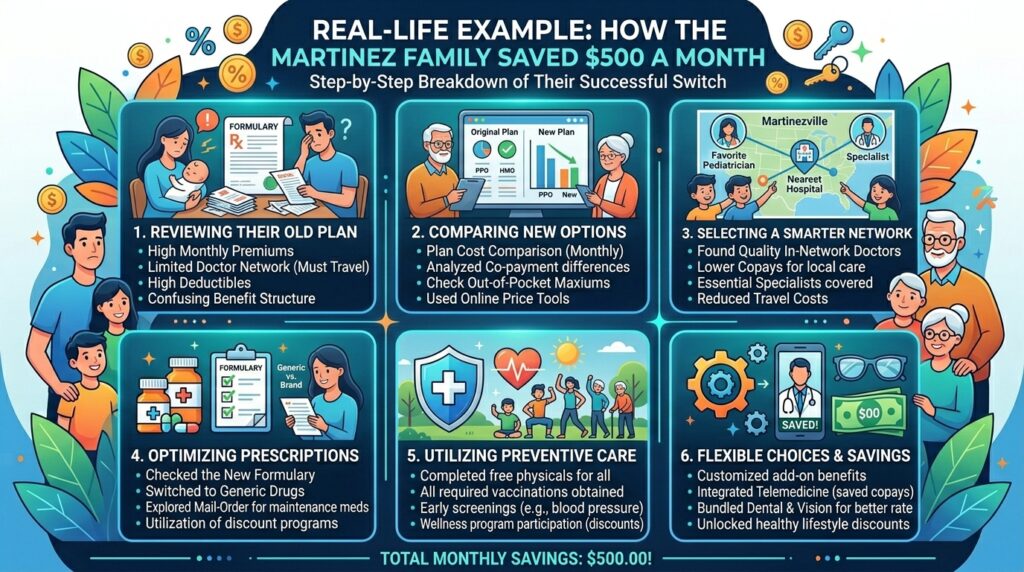
Let me tell you about the Martinez family. They live in San Antonio. Mom, dad, and two kids. They were paying $1,200 a month for COBRA coverage after a job change.
They went to Healthcare.gov and found:
- Income: $75,000 per year
- Premium tax credit: $650 per month
- Oscar Silver plan premium after credit: $320 per month
- Out-of-pocket costs estimated: Lower than their old plan
Total savings: Over $500 per month .
Frequently Asked Questions About Health Insurance in Texas
Q: When can I enroll in health insurance for 2026?
A: Open Enrollment runs from November 1, 2025, through January 15, 2026. If you enroll by December 15, 2025, coverage starts January 1, 2026 .
Q: What if I miss open enrollment?
A: You can only enroll outside open enrollment if you have a qualifying life event. Things like losing other coverage, getting married, having a baby, or moving to a new area.
Q: How much does health insurance cost for a family in Texas?
A: Costs vary wildly based on income, location, and plan choice. After subsidies, many families pay between $200 and $800 per month. Some qualify for plans under $100 per month with strong subsidies.
Q: What’s the cheapest health insurance plan in Texas?
A: The cheapest plans are usually Bronze plans from Ambetter or Oscar. But remember, cheap monthly premiums often mean higher costs when you need care. Always compare total costs, not just premiums .
Q: Does Texas have its own health insurance marketplace?
A: No. Texas uses the federal marketplace, Healthcare.gov. You can’t enroll through a state-run site.
Q: Can I get health insurance if I have a pre-existing condition?
A: Yes. Under the ACA, insurance companies cannot deny coverage or charge more for pre-existing conditions. This includes diabetes, asthma, cancer, and pregnancy .
Q: What’s the best health insurance for a family with diabetes?
A: Look at Ambetter’s Enhanced Diabetes Care Silver plans or Oscar’s condition-focused plans. Both offer $0 copays for insulin and diabetes supplies .
Q: Are there health insurance plans that include dental for kids?
A: Yes. All marketplace plans include pediatric dental coverage. Some include it in the medical plan, others offer separate dental plans .
Q: How do I know if I qualify for subsidies?
A: Go to Healthcare.gov and fill out an application. It will calculate your eligibility based on income and family size. Generally, families earning between 100% and 400% of the federal poverty level qualify for help.
Q: What’s the best health insurance for a family that doesn’t qualify for subsidies?
A: If you don’t qualify for subsidies, compare off-exchange plans directly from insurers like BCBSTX or Ambetter. Sometimes these have different pricing. Also consider HDHPs with HSAs to save on taxes .
Conclusion: Finding Your Family’s Best Health Insurance in Texas
Finding affordable health insurance for your family in Texas takes some work, but it’s worth it. The peace of mind alone is priceless.
Start at Healthcare.gov. See what subsidies you qualify for. Then compare plans from Ambetter, Oscar, and BCBSTX based on your family’s specific needs.
If you have a chronic condition like diabetes, look at condition-specific plans that offer $0 costs for essential care . If you’re generally healthy, consider an HDHP with an HSA to save on premiums and build tax-advantaged savings .
Remember these key dates: Open Enrollment runs from November 1, 2025, to January 15, 2026. Don’t wait until the last minute. Give yourself time to compare options and find the right fit.
Your family’s health is too important to leave to chance. Get covered today.