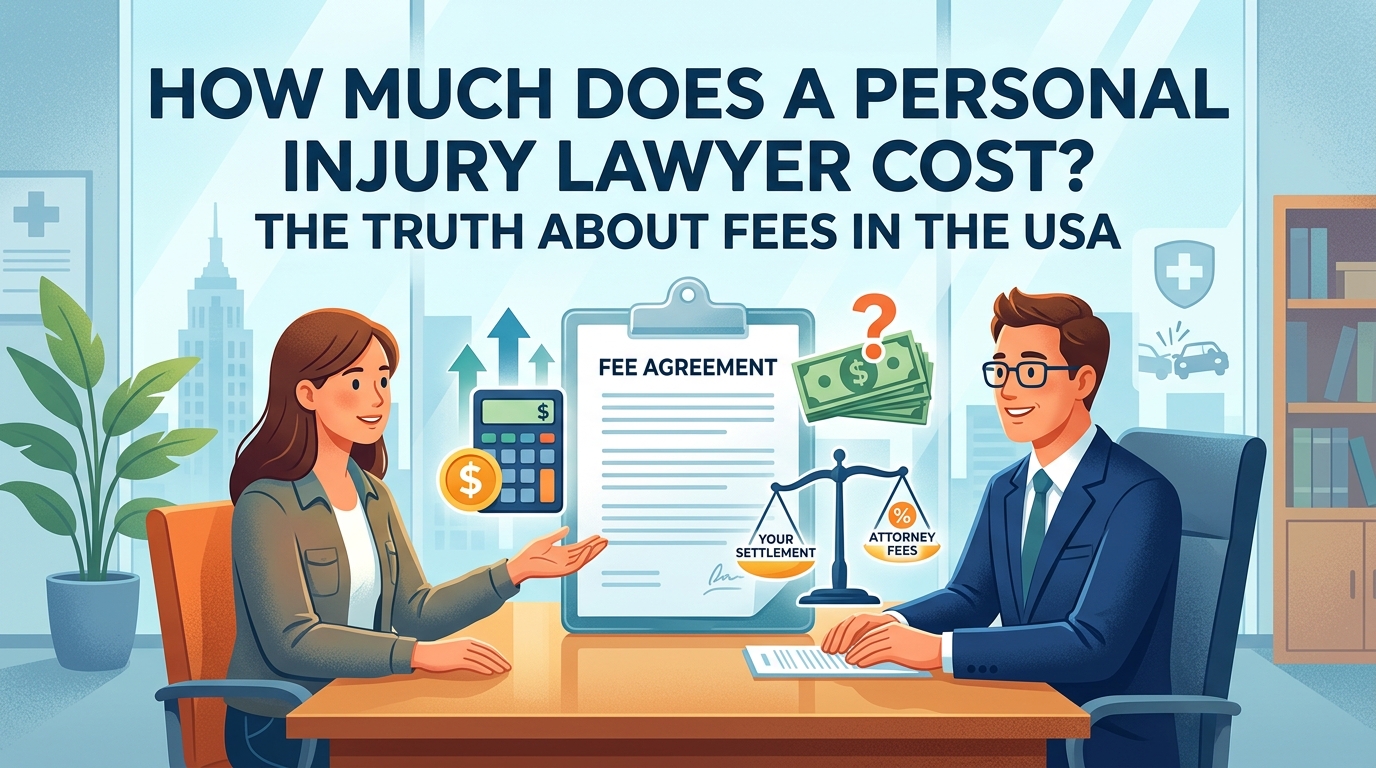
You are driving home from work. It is raining hard. Suddenly, the car behind you doesn’t stop in time. Bam. You feel a jolt. Your neck hurts. Your car is damaged. Your peaceful evening is ruined.
In the days that follow, the pain doesn’t go away. You miss work. The medical bills start piling up. The insurance company for the person who hit you calls. They sound friendly, but they are already talking about settling quickly.
Your head is spinning. You know you need help. You know you need a lawyer. But then, a terrifying thought creeps in: “How much does a personal injury lawyer cost in the USA? Can I even afford one?”
If this sounds familiar, take a deep breath. You are not alone. This is the number one question people ask after an accident. The good news? The answer is usually a relief, not a shock.
In this guide, we are going to break down exactly how these lawyers get paid. We will look at the different types of fees, the hidden costs you need to ask about, and how to make sure you are getting a fair deal. By the end, you will understand that hiring a personal injury lawyer is often the most affordable decision you can make after an accident.For getting information about creadit card and loans click here.
The Big Secret: “No Win, No Fee”

The first thing you need to know is that the way a personal injury lawyer gets paid is completely different from other types of lawyers.
If you hire a lawyer to write a will or help you buy a house, you usually pay them by the hour. They might charge $300 an hour, and you pay that bill every month, regardless of the outcome.
But if you hire a personal injury lawyer to help with a car accident or a slip and fall case, they almost always work on what is called a “contingency fee.”
This is a fancy Latin term that simply means: “I only get paid if you get paid.”
That’s right. If your lawyer doesn’t win your case or get you a settlement, you don’t owe them a dime for their time. This is the golden rule of personal injury law in the USA.
This system exists for a very good reason. It allows anyone—regardless of their bank account—to access high-quality legal help. It also motivates the lawyer to work as hard as possible to get you the maximum amount of money.
Breaking Down the Contingency Fee Percentage
So, if the lawyer only gets paid when you win, how much do they take? This is the core of the question, “How much does a personal injury lawyer cost in the USA?”
The standard industry rate is a percentage of the final settlement or court award. This percentage typically falls into a specific range.
The Typical Range: 33% to 40%
Most personal injury lawyer fees fall between 33% and 40% of the total amount they recover for you.
- 33% (One-Third): This is the most common rate. It usually applies to cases that settle without having to file a lawsuit. The lawyer sends demand letters, negotiates with the insurance company, and gets you a check. They take one-third. You keep two-thirds.
- 40% (or Higher): This rate often applies if the case becomes more complicated. For example, if the insurance company refuses to play fair and your lawyer has to file a lawsuit and go to court, the fee might increase to 40% or more. This reflects the massive amount of extra work involved in a trial.
A Simple Example
Let’s say you are in a car accident and the other driver’s insurance company agrees to a settlement of $60,000.
- If your personal injury lawyer has a 33% fee, they would take $20,000.
- You would receive $40,000 before any other costs are deducted.
But wait—we need to talk about those “other costs.” The percentage isn’t the only piece of the puzzle.
Beyond the Percentage: Case Costs and Expenses
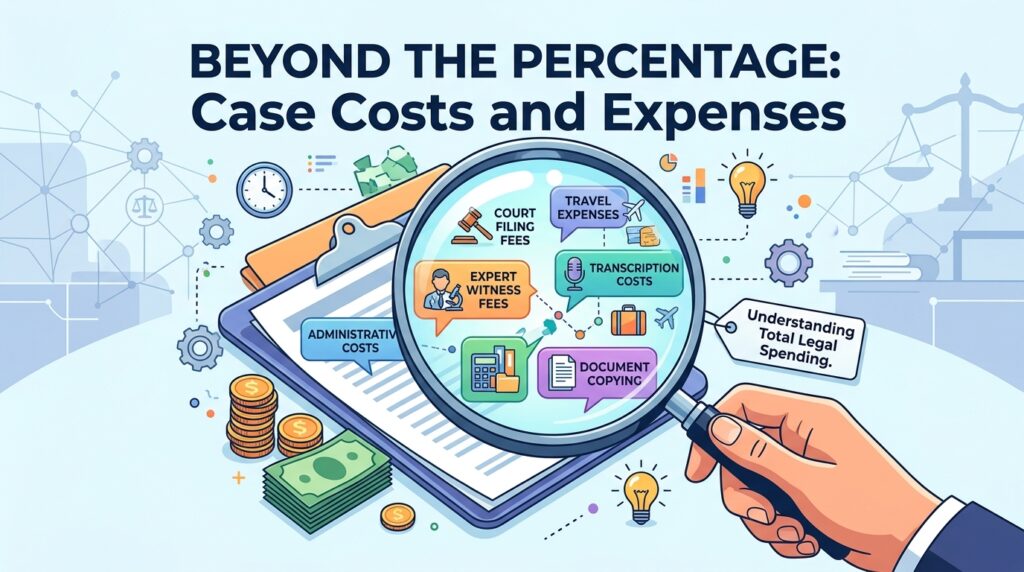
When you ask, “How much does a personal injury lawyer cost in the USA?”, the percentage is only half the story. The other half is “costs.”
Think of it this way: The lawyer’s fee is for their time and expertise. But building a case costs money. These are called “Case Costs” or “Expenses of Suit.”
What Are These Costs?
To prove your case, a personal injury lawyer might need to spend money on:
- Medical Records: Hospitals and doctors charge a fee to copy and send your medical records.
- Police Reports: There is usually a small fee to get the official accident report.
- Expert Witnesses: If you need a doctor to testify about your injuries or an engineer to explain why a product was dangerous, these experts charge thousands of dollars an hour.
- Court Filing Fees: It costs money to file a lawsuit in court.
- Depositions: Taking sworn statements from witnesses requires a court reporter, which costs money.
Who Pays for These Costs?
Here is where it gets a little tricky, and where you need to read the fine print.
Usually, the personal injury lawyer pays for all these costs upfront while the case is ongoing. You don’t have to pay anything out of pocket. Then, at the end of the case, these costs are reimbursed to the lawyer out of your settlement.
There are two main ways this happens:
- Costs are deducted before the fee is calculated.
- Settlement: $60,000
- Costs: $5,000
- Remaining Amount: $55,000
- Lawyer’s 33% Fee: $18,150 (33% of $55,000)
- You Get: $36,850
- Costs are deducted after the fee is calculated. (Less common, but you need to check)
- Settlement: $60,000
- Lawyer’s 33% Fee: $20,000
- Remaining: $40,000
- Costs: $5,000
- You Get: $35,000
Always ask a potential personal injury lawyer to explain exactly how they handle costs. A good lawyer will be transparent about this from the very first meeting.
The “Free Consultation” Myth and Reality
You have probably seen commercials for personal injury lawyer services that say, “Call now for a free consultation!”
This is not a myth. It is 100% true.
All reputable personal injury lawyers offer a free initial consultation. This is a meeting (in person, by phone, or by video) where you tell them your story, and they tell you if you have a case.
This meeting is crucial for two reasons:
- For You: You get to interview the lawyer. Do they seem trustworthy? Do they have experience with cases like yours? Do they communicate clearly? You are hiring them, so you need to make sure it’s a good fit.
- For Them: The lawyer gets to see if your case is worth taking. They will look at who was at fault, how badly you were hurt, and whether there is insurance money available.
Because they work on contingency, they will only take your case if they believe they can win and get you compensation. This is a built-in filter that protects you.
When an Hourly Rate Makes Sense

While contingency fees are the standard answer to “How much does a personal injury lawyer cost?”, there are rare situations where a lawyer might suggest a different arrangement.
Sometimes, a case might be very small, or it might be a specific issue that doesn’t involve a big insurance claim. For example, maybe you just need a lawyer to review a settlement offer from an insurance company to make sure you aren’t getting cheated.
In these limited situations, a lawyer might offer to work for an hourly rate. This could range from $200 to $600 per hour, depending on the lawyer’s experience and location.
However, for the vast majority of accident victims seeking compensation for medical bills and pain and suffering, the contingency fee model is the only one that makes sense. It aligns the lawyer’s interests with your own.
Red Flags: What to Watch Out For
Now that you understand the costs, let’s talk about protecting yourself. Not all lawyers are created equal. Here are some red flags to watch out for when you are asking, “How much does a personal injury lawyer cost in the USA?”
1. The Lawyer Who Promises a Specific Amount
If a lawyer tells you, “I can get you $100,000,” during the first phone call, run the other way. No ethical lawyer can guarantee a specific outcome before they have reviewed all the evidence—your medical records, the police report, and the insurance policy limits. This is a sales tactic, not legal advice.
2. The “Hidden Costs” Trap
As we discussed, costs are normal. But a good lawyer will explain them clearly upfront. If a lawyer is vague about costs or hands you a long contract and says, “Just sign here, it’s standard,” be very careful. Ask them to explain the “costs” section in plain English.
3. The Settlement Pusher
Some less reputable lawyers are just looking for a quick buck. They might pressure you to accept a fast, low settlement from the insurance company so they can collect their 33% and move on to the next case. A great personal injury lawyer will fight for a settlement that truly covers your long-term needs, not just your immediate bills.
4. The Unlicensed Specialist
Make sure the lawyer you hire actually practices personal injury law. A divorce lawyer or a real estate lawyer does not have the specific skills needed to handle a medical malpractice or car accident case. Look for a lawyer whose primary focus is personal injury.
The True Value: Why a Lawyer is Worth the Cost

At this point, you might still be thinking, “33% sounds like a lot of money.” It can be. But let’s look at the bigger picture.
Studies have consistently shown that people who hire a personal injury lawyer end up with significantly more money in their pockets than people who try to handle the claim on their own, even after paying the lawyer’s fees.
The Insurance Company Advantage
Insurance companies are not your friends. They are massive corporations with teams of adjusters and lawyers whose job is to pay you as little as possible. They are trained to use your words against you and to pressure you into settling for a fraction of what your case is worth.
The Lawyer’s Leveling Power
When you hire a personal injury lawyer, you level the playing field. The insurance company suddenly knows they are dealing with a professional who understands the law and knows the true value of your claim.
A good lawyer will:
- Investigate the accident thoroughly to gather all the evidence.
- Calculate the true value of your claim, including future medical costs and lost wages.
- Handle all communication with the insurance company so you don’t accidentally say something that hurts your case.
- Negotiate aggressively to get you the maximum settlement.
- Take the case to trial if the insurance company refuses to be fair.
In short, a good lawyer often doubles or triples the amount of money you would get on your own. When you look at it that way, their fee isn’t a cost—it’s an investment that pays off.
Frequently Asked Questions (FAQs)
Let’s tackle some of the most common questions people have about the cost of legal help after an accident.
Do I have to pay a personal injury lawyer if I lose?
Generally, no. The entire point of a contingency fee is that you only pay if you win. If your lawyer takes your case and you lose at trial, you typically do not owe them anything for their time. However, you might still be responsible for the “case costs” we discussed earlier (like court filing fees). Some lawyers will waive these if you lose, while others will require you to pay them. This is an important question to ask upfront: “If we lose, am I responsible for the costs?”
How much does a personal injury lawyer cost for a small claim?
Even for small claims, most lawyers work on a contingency fee. The percentage is usually the same (33%), but because the total amount is smaller, you need to make sure it’s worth the lawyer’s time. Some lawyers might have a minimum fee. For a very small fender bender with no injuries, you might be better off handling it directly with the insurance company, but it’s always worth a free consultation to find out.
Can I negotiate the contingency fee?
It doesn’t hurt to ask, but don’t be surprised if the answer is no. The standard 33% rate is well-established. If your case is extremely large and straightforward, a lawyer might be willing to discuss a sliding scale (e.g., 33% for the first $100,000, and 25% for anything above that). But for the average case, the rate is usually fixed.
What if the insurance company offers a settlement before I hire a lawyer?
Insurance companies often try to settle claims quickly, sometimes within days of an accident. Do not accept any settlement until you know the full extent of your injuries. Some injuries, like back pain or brain injuries, can take weeks or months to appear. If you settle too soon, you cannot go back for more money later. It is always best to at least consult with a personal injury lawyer before signing anything.
How do I find a good personal injury lawyer?
Start by asking friends and family for recommendations. You can also check state bar association websites for referrals. Read online reviews, but take them with a grain of salt. Most importantly, take advantage of those free consultations. Talk to two or three different lawyers. Ask them about their experience, their fee structure, and how they handle costs. Choose the one you feel most comfortable with.
Conclusion: Don’t Let Fear of Cost Stop You
After an accident, your focus should be on healing, not on worrying about money. The American legal system has built-in protections to ensure that access to justice isn’t just for the wealthy.
The contingency fee model means that a personal injury lawyer is a partner in your recovery, not an upfront expense. They only succeed when you succeed. Their motivation is aligned with yours: to get you the maximum compensation possible so you can cover your bills, replace your lost income, and move forward with your life.
So, if you are lying in bed at night with a sore neck and a pile of medical bills, wondering how you will afford help, stop worrying. Pick up the phone. Call a reputable personal injury lawyer for that free consultation. You have nothing to lose and everything to gain.
Understanding how much a personal injury lawyer costs is the first step. Taking action to protect your rights is the second. You’ve got this.