Talking about life insurance is about as fun as going to the dentist.
But here’s the thing. If someone depends on your paycheck, you need to read this. I’m not going to use big fancy words. I won’t sell you anything. Instead, I’ll walk you through life insurance plans USA like we’re having coffee.
You’ll learn what works, what’s a waste of money, and how to pick the right plan without losing sleep.
Ready? Let’s dive in.
Why Most People Ignore Life Insurance (Until It’s Too Late)

I get it. You’re busy. Bills are due. The kids have soccer practice.
Who wants to think about… death?
But here’s a reality check. A friend of mine lost her husband at 42. Heart attack. Out of nowhere. He had a small policy from work. It paid $50,000. That sounds like a lot until you realize it covered only 10 months of mortgage and daycare.
She had to sell their home.
That story stuck with me. The truth is, life insurance plans USA offer a safety net. But only if you buy the right kind. And only if you buy enough.
So let’s break this down. No stress. No pressure.
What Exactly Is Life Insurance? (Explained Like You’re 15)
Life insurance is a contract.
You pay a small amount each month (that’s your premium). The company promises to pay a larger amount (the death benefit) to the people you name when you pass away.
Think of it like this:
- You pay $50/month.
- The company pays $500,000 to your family.
- That money is tax-free.
Simple, right?
But not all plans are the same. In fact, choosing the wrong one is like buying snow boots for a beach vacation. It just doesn’t fit.
The Two Main Types of Life Insurance Plans in the USA
Let me save you hours of research.
There are only two types you really need to know about. Everything else is just a fancy version of these.
Term Life Insurance The Simple, Cheap Choice
Term life is straightforward.
You pick a length of time. Usually 10, 20, or 30 years. You pay a fixed price. If you die during that time, your family gets paid.
If you outlive the term? Nothing happens. The policy ends. No refunds.
Example: Sarah is 35. She buys a 20-year term policy for $500,000. She pays $35/month. If she dies before 55, her kids get $500k. If she turns 56, the policy expires.
Why do people buy term? Because it’s cheap. A healthy 30-year-old can get $500,000 of coverage for less than their Netflix and Spotify bills combined.
Permanent Life Insurance The Long-Term Player
Permanent lasts your whole life.
As long as you pay the premiums, it pays out. No expiration date. It also builds cash value. That’s a savings account inside the policy that grows over time.
But here’s the catch. It costs a lot more.
Example: The same 30-year-old paying $35/month for term might pay $300–$400/month for permanent.
So why buy it? Two reasons.
- You want coverage no matter when you die.
- You want to use the cash value while you’re alive (for retirement, college, or emergencies).
Most people don’t need permanent. But for some, it makes sense.
Now that you know the basics, let’s dig deeper into life insurance plans USA and how to pick the right one for your exact situation.
Term Life vs. Whole Life – Which One Wins?
This is the big debate. Fans of whole life say it’s an investment. Fans of term say it’s a rip-off.
Let me give you the honest truth.
| Feature | Term Life | Whole Life (a type of permanent) |
|---|---|---|
| Length | 10–30 years | Entire life |
| Price | Low | High (5–10x term) |
| Cash value | No | Yes |
| Investment growth | No | Slow, guaranteed |
| Best for | Young families, mortgages, debt | Estate planning, special needs, business |
Here’s my rule of thumb.
Buy term if:
- You have kids under 18.
- You have a mortgage.
- You have student or car loans.
- You’re on a tight budget.
Buy whole life only if:
- You already max out your 401(k) and Roth IRA.
- You have a special needs child who will always depend on you.
- You own a business with a partner.
- You want to leave tax-free money to heirs.
For 95% of families reading this? Term life is the smarter play.
How Much Life Insurance Do You Actually Need?
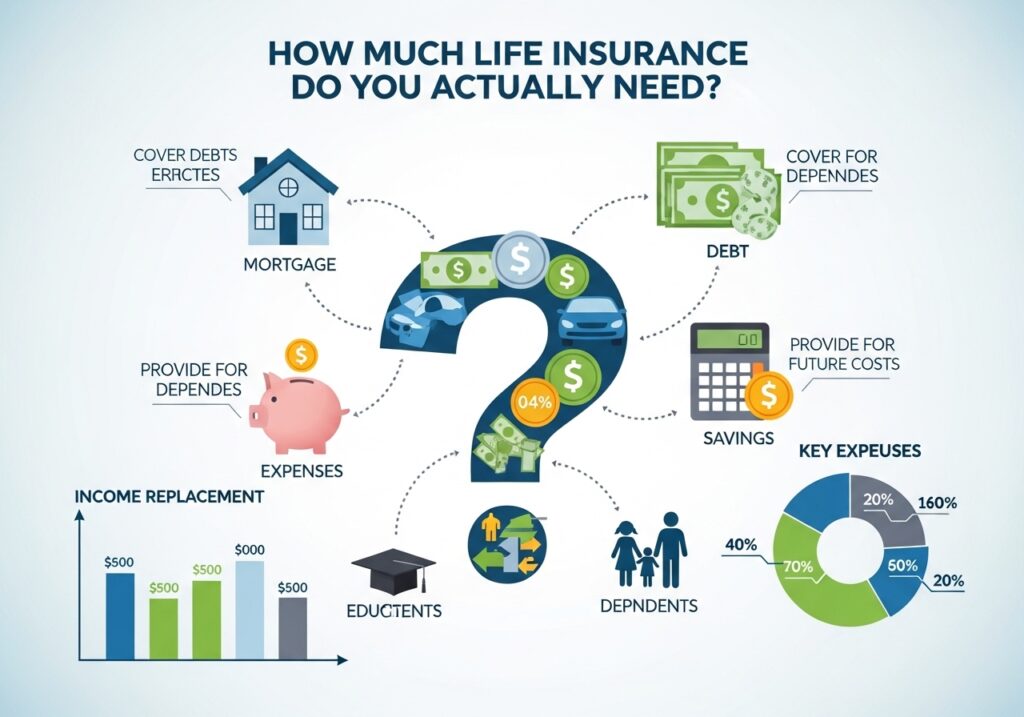
Most people guess.
They say, “Eh, $100,000 sounds good.”
But let’s do some real math. And don’t worry – I’ll keep it simple.
A common rule is 10x to 15x your yearly income.
So if you earn $60,000, you’d want $600,000 to $900,000.
But that’s just a starting point. Let’s use the REAL method. Multiply these four numbers:
1. Final expenses – $15,000 (funeral, medical bills, probate).
2. Debt payoff – Mortgage ($200,000) + car loans ($20,000) + credit cards ($5,000) = $225,000.
3. Income replacement – Your salary x number of years until kids are grown. Example: $50,000 x 10 years = $500,000.
4. College fund – Two kids x $50,000 each = $100,000.
Now add them up:
$15,000 + $225,000 + $500,000 + $100,000 = $840,000.
That’s your number. Round up to $1 million if it makes you sleep better.
Most people are shocked at how high this is. But here’s the good news. A million-dollar term policy for a healthy 35-year-old costs around $50–$80/month.
That’s less than takeout for a family of four.
The Best Life Insurance Companies in the USA for 2026
Not all insurers are created equal.
You want a company that actually pays claims. You want one with good customer service. And you want one that won’t jack up your rates later.
Here are my top picks based on financial strength, price, and customer satisfaction.
Best Overall – Banner Life
Banner has been around forever. They have an A+ rating from AM Best (that’s the gold standard). Their term rates are often the lowest for healthy people. And they have a great conversion option if you ever want to switch to permanent.
Best for No-Exam – Haven Life
Haven is run by MassMutual, a huge company. They offer instant online approvals. Most people don’t need a medical exam if they’re healthy and under 50. You can get a policy in 15 minutes.
Best for Seniors – Mutual of Omaha
If you’re over 60, Mutual of Omaha is solid. They offer guaranteed issue policies (no health questions) for people up to 85. Prices are fair for what you get.
Best for High Net Worth – New York Life
If you need more than $5 million in coverage, New York Life is the standard. They are one of the few mutual companies. That means policyholders own the company, not shareholders. They pay dividends.
Best Budget Pick – Ladder
Ladder is 100% digital. You can adjust your coverage up or down as life changes. Want to lower your death benefit at 55 to save money? Two clicks. It’s that easy.
When comparing life insurance plans USA, always check at least three companies. Prices can vary 40% for the exact same coverage.
How Life Insurance Underwriting Works (The Health Stuff)
Underwriting is just a fancy word for “checking your risk.”
The insurance company wants to know: How likely are you to die while insured?
They look at:
- Age
- Health history
- Family health history (parents, siblings)
- Smoking status
- Dangerous hobbies (skydiving, rock climbing)
- Driving record
Then they put you in a “health class.”
From best to worst:
- Preferred Plus – Perfect health. No meds. Normal weight. You get the lowest rates.
- Preferred – Very good health. Maybe one well-managed condition like mild high blood pressure.
- Standard Plus – Average health. Slightly high cholesterol. Overweight but not obese.
- Standard – Average for your age. Takes blood pressure pills. A bit heavier.
- Substandard (Table rated) – Health issues like diabetes, heart disease, or past cancer. You pay more.
- Declined – Too high risk. No policy offered.
Here’s the secret most people don’t know.
You can improve your class in 3–6 months. Lose 15 pounds. Lower your A1C. Quit smoking. Then reapply. I’ve seen people cut their rates in half just by waiting and getting healthier.
Riders The Extra Features You Might Want
A rider is an add-on. Like extra cheese on a pizza. Costs a little more, but sometimes worth it.
Here are the most useful riders for life insurance plans USA:
Accelerated Death Benefit Rider – Free on most policies. If you get terminally ill (less than 12 months to live), the company pays part of your death benefit early. Use it for medical bills or a final trip with family.
Waiver of Premium Rider – If you become disabled and can’t work, the company pays your premiums for you. Coverage stays active. This is cheap – usually $5–$10/month.
Child Term Rider – Covers all your kids for a small amount (like $10,000–$20,000) for around $6/month per child. Good for funeral costs and time off work.
Accidental Death Benefit Rider – Doubles the payout if you die in an accident. But most people die from illness, not accidents. Save your money on this one.
Long-Term Care Rider – Lets you use part of your death benefit to pay for nursing home or in-home care if you need it before you die. Very useful for permanent policies.
Don’t go crazy with riders. Most people only need the accelerated death benefit (free) and waiver of premium (cheap).
Common Life Insurance Mistakes (And How to Avoid Them)
I’ve seen thousands of families buy life insurance. And I’ve seen the same five mistakes over and over.
Don’t be that person.
Mistake #1 – Buying Only What Work Gives You
Your job might offer free life insurance. Usually 1x your salary. That sounds generous. But if you earn $50,000, that’s only $50k. That won’t even pay off a used car and a funeral.
Worse? If you quit or get fired, the policy stays with your old job. And you lose it.
Always buy your own policy outside of work. Use work insurance as a bonus, not your main plan.
Mistake #2 – Naming a Minor as the Beneficiary
This is huge.
If you name your 9-year-old as the beneficiary, the court takes control of the money. It goes into a locked account until they turn 18. Then they get a giant check. All at once. With no guidance.
Instead, name a trusted adult (your spouse, sibling, or parent). Or set up a simple trust. It costs very little and protects your kids.
Mistake #3 – Buying “Mortgage Protection” Insurance
Ever get a letter that says, “Pay off your mortgage if you die!”?
That’s mortgage protection insurance. It’s a type of decreasing term life. The payout goes down as your mortgage balance goes down. But you pay the same premium the whole time.
It’s almost always more expensive than regular term life. Avoid it.
Mistake #4 – Waiting Until You “Need It”
The number one regret I hear?
“I should have bought life insurance when I was younger and healthier.”
Every year you wait, the price goes up about 8–10%. A 40-year-old pays double what a 30-year-old pays for the same policy.
Buy now. Even a small policy. You can always increase it later.
Mistake #5 – Lying on the Application
Don’t hide that you smoke. Don’t lie about your weight. Don’t “forget” that DUI from three years ago.
Insurance companies check. They have access to your medical records, pharmacy history, and MIB report (like a credit report for insurance).
If they find a lie within the first two years, they can cancel your policy and return your premiums. Your family gets nothing.
Tell the truth. You might pay a little more. But at least they WILL pay your claim.
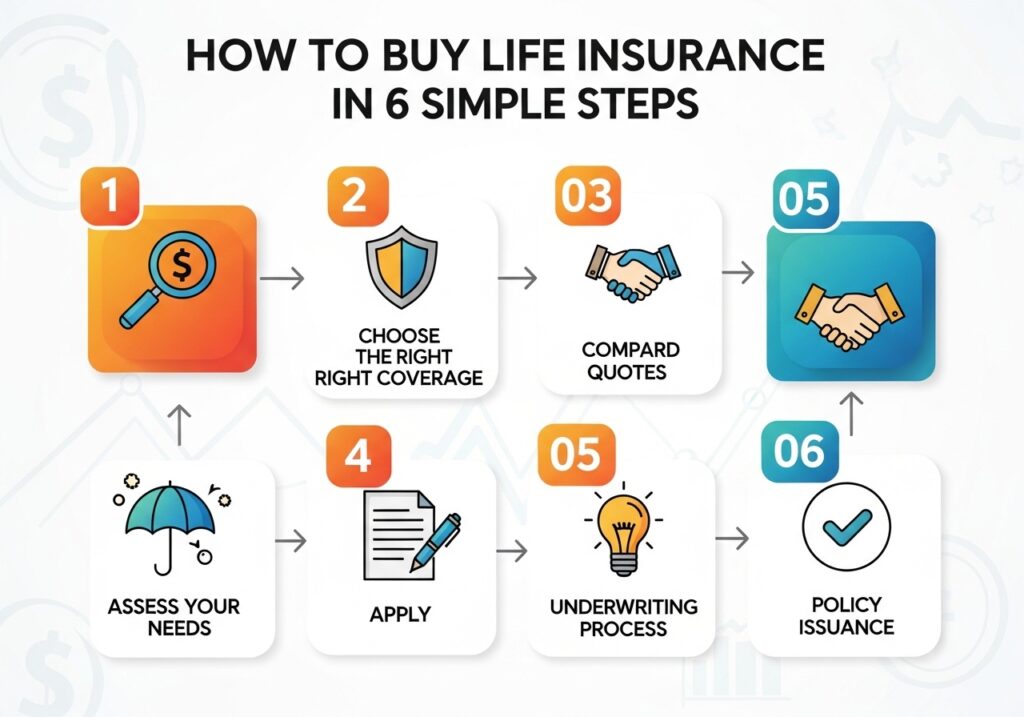
How to Buy Life Insurance in 6 Simple Steps
Ready to stop reading and start doing?
Follow this exact process. It works for 95% of people.
Step 1: Calculate your number – Use the method above. Write it down.
Step 2: Decide your term length – Choose until your youngest kid is grown. Example: If your baby is 2, get a 20-year term. If you’re 50 with no kids, get a 10-year term for income replacement until retirement.
Step 3: Shop around – Use a comparison site like Policygenius or Quotacy. Or go directly to Ladder, Haven Life, and Banner Life for quotes.
Step 4: Apply online or by phone – Most companies let you start online. Expect to answer health questions. Some will ask for a phone interview (10 minutes). Be honest.
Step 5: Take the medical exam (if required) – A nurse comes to your home or office. They take blood, urine, and check blood pressure. Takes 20 minutes. It’s free.
Step 6: Review and sign – Once approved, read the policy. Make sure the beneficiary name is correct. Then pay your first premium. Coverage starts immediately.
That’s it. You’re done.
Most people go from “I should buy insurance” to “I have coverage” in 3–4 weeks.
Life Insurance for Special Situations
Not everyone fits the “married with 2.5 kids and a white picket fence” mold.
Here’s how life insurance plans USA work for real people in real situations.
For Stay-at-Home Parents
You don’t earn a paycheck. But you provide huge value. Childcare, cleaning, driving, cooking, tutoring. Replacing that costs $40,000–$70,000 per year.
Buy a $250,000–$500,000 term policy on the stay-at-home parent. It’s very cheap because they’re often healthier than working parents.
For Single People
If no one depends on your income, you may not need life insurance. But consider a small $25,000–$50,000 policy for funeral costs and final expenses. It saves your parents or siblings from a sudden financial burden.
For Small Business Owners
You need key person insurance. The business buys a policy on you. If you die, the business gets cash to hire a replacement or pay off debts. Also useful if you have a business partner. A buy-sell agreement funded by life insurance is the standard.
For New Parents
Congratulations! Now buy life insurance immediately. Even before you leave the hospital. Being a parent is the #1 reason to get covered. A 20-year term that ends when your child is 20 is perfect.
For People with Pre-Existing Conditions
Diabetes, heart disease, cancer history, depression, anxiety, sleep apnea – you can still get coverage.
Some companies specialize in “impaired risk.” Try Prudential, Lincoln National, or John Hancock. You’ll pay more, but you’ll get coverage.
If you’ve been denied before, look for “guaranteed issue” policies. They ask zero health questions. But they’re expensive and have a 2-year waiting period. If you die in year one, they only refund premiums plus interest.
The Truth About Cash Value Life Insurance
Let me be blunt.
Cash value life insurance (whole life, universal life, variable life) is sold, not bought.
That means insurance agents make huge commissions on it. Often 80–100% of your first year’s premium goes to the agent.
Compare that to term life, where the agent might make 20–40% of your first year’s premium.
See the incentive?
Cash value policies CAN make sense for a small group of people. We’re talking high earners ($300k+ per year) who have already maxed out every other investment account.
For everyone else? Buy term. Invest the difference in a low-cost index fund (like VTI or SPY). You’ll come out way ahead.
Here’s the math.
Scenario A: Buy $500k whole life. Pay $400/month for 30 years. Cash value at year 30 might be $150,000. Death benefit stays $500k.
Scenario B: Buy $500k term life. Pay $40/month for 30 years. Invest $360/month in an S&P 500 index fund. After 30 years (assuming 7% average return), you have roughly $450,000. Plus the $500k death benefit if you die. Plus you can spend the $450k while alive.
Which sounds better to you?
I thought so.
Life Insurance FAQs (Your Burning Questions Answered)
I talk to people about life insurance every single week. Here are the questions I hear most.
Q: Can I have more than one life insurance policy?
Yes. Many people have a small policy from work, plus a larger personal policy. You can stack them. Each pays separately.
Q: What happens if I stop paying premiums?
For term life: The policy lapses (ends). No refunds. For permanent: The company uses your cash value to pay premiums until it runs out. Then it lapses.
Q: Is life insurance taxable for my family?
No. The death benefit is 100% federal income tax-free. Your family gets every penny. State taxes? Also no. It’s one of the best tax breaks out there.
Q: Can I buy life insurance on my parents?
Yes, if they agree. You need their signature. Adult children often buy small policies on aging parents to cover funeral costs. It’s called “final expense insurance.” Usually $10,000–$25,000.
Q: How long does it take to get paid after a death?
Usually 2–4 weeks. The beneficiary files a claim online or by phone. The company asks for a death certificate. That’s it.
Q: Do I need life insurance after retirement?
Maybe. If you have a spouse who depends on your pension or Social Security, yes. If your kids are grown, your house is paid off, and you have savings? Probably not.
Q: Can I change my beneficiary?
Yes. At any time. Fill out a simple form online or mail it in. You should review your beneficiaries every 3–5 years or after a divorce, marriage, or birth.
Q: What’s the difference between “term life” and “whole life” that I see advertised on TV?
TV ads usually push whole life because it’s more profitable for the company. They say “coverage that lasts forever” and “cash value you can use.” Ignore the hype. Most families need term.
Q: Are online life insurance companies safe?
Yes, as long as they’re licensed in your state. Check the NAIC (National Association of Insurance Commissioners) website to confirm. Haven Life, Ladder, and Bestow are all backed by huge, old-school insurers.
Q: What if I’m in perfect health? Can I skip the medical exam?
Sometimes. Many companies offer “accelerated underwriting” for healthy people under 50. You answer detailed health questions, and they check your prescription history. No physical exam. But if you want the absolute lowest rates, take the exam anyway.
Conclusion – Your Next Move
We covered a lot of ground.
You learned the difference between term and permanent. You calculated how much coverage you actually need. You saw which companies are worth trusting. And you found out how to avoid the most common and costly mistakes.
Now here’s what I want you to do today.
Step one: Write down your number. Use the calculator method above. Don’t guess.
Step two: Get three online quotes for a 20-year term policy at that amount. Use Ladder, Haven Life, and one more like Banner or Protective.
Step three: Apply tonight. Even if you don’t finish the medical exam for two weeks, starting the application locks in today’s rates. Rates are based on your age when you apply, not when you finish.
Here’s the bottom line.
Life insurance plans USA are not exciting. They won’t make you rich. But they will make sure your family stays in their home, pays for college, and doesn’t have to hold a bake sale to bury you.
That’s the whole point.
You work hard for the people you love. This is how you protect them when you’re no longer around.
So go ahead. Spend 20 minutes. Get that quote. Hug your kids. And check this off your list.
You just did something really smart. And future you (and your family) will thank you for it.

