
You started your own business because you wanted freedom. No more pointless meetings. No more asking for Fridays off. No more bad coffee from a breakroom you hate.
But then came the scary part.
You realized you didn’t have a safety net anymore. No employer calling you into HR to hand you a shiny insurance card. No automatic deduction from a paycheck for a solid PPO plan.
Health Insurance USA for Self Employed

Suddenly, health insurance USA for self employed folks became your new full-time job.
I’ve been there. Sitting at my kitchen table at midnight, staring at 27 open browser tabs, trying to figure out what a “deductible” really means. It’s confusing. It’s expensive. And it feels like the system was built for big companies, not for you.
But here is the good news. You have more power than you think. You have options. And by the end of this guide, you will know exactly how to find a plan that works for your budget, your health, and your sanity.
Let’s dive in.
Why Being Self-Employed Changes Everything
When you work for a big company, your employer usually pays about 70-80% of your health insurance premium. You barely think about it. It just happens.
When you are self-employed, you become the HR department, the finance team, and the worried person at 2 AM.
Here is what changes:
- No employer subsidy. You pay the full price. That hurts.
- You pay both sides of the payroll tax (but we will get to the tax break later – it’s a good one).
- You have to shop on your own. No one is handing you a simple list of three options.
- Your income may go up and down. Some months are great. Some months are “ramen every night” months. That makes budgeting tricky.
But stop worrying. Thousands of freelancers, consultants, plumbers, artists, and small business owners figure this out every single year. So will you.
The Number One Mistake Self-Employed People Make

I see this all the time.
A freelancer skips getting real insurance because “I’m young and healthy.” Then they trip walking their dog. Or they get appendicitis. Or they wake up with a weird chest pain that turns out to be nothing – but the ER visit costs $6,000.
Please don’t be that person.
The biggest mistake is doing nothing. The second biggest mistake is buying a “cheap” plan that doesn’t actually cover anything.
So let’s talk about legit options for health insurance USA for self employed workers. Real plans. Real coverage. No scams.
Your Real Options (Ranked From Safest to Riskiest)
Not all insurance is created equal. Here is the honest breakdown.
1. ACA Marketplace Plans (Obamacare)
This is usually your best bet. I know you have heard scary stories. But the Affordable Care Act (ACA) was designed specifically for people like you.
Why it works for the self-employed:
- You cannot be denied for pre-existing conditions. Asthma? Diabetes? Past knee surgery? They have to cover you.
- You get subsidies (tax credits) based on your income. If you don’t make a ton of money, the government helps pay your monthly premium.
- Plans cover essential health benefits. That means mental health, prescriptions, maternity, and emergency services.
- Open Enrollment is usually November 1 – January 15. But if you lose other coverage or have a life change, you can get a Special Enrollment Period.
Real example:
My friend Sarah is a graphic designer. She makes $45,000 a year. She went on Healthcare.gov and found a Silver plan for $287 per month after subsidies. Her deductible is $2,500. She uses it for therapy and annual checkups. It works.
Downside? If you earn a high income (over about $58,000 for a single person), you may not get subsidies. Then plans can feel expensive.
2. Private Off-Marketplace Plans
These are ACA-compliant plans that you buy directly from an insurance company or broker. Not through Healthcare.gov.
Pros:
- Same essential benefits as marketplace plans.
- Sometimes lower premiums for higher earners.
- You can buy them any time of year if you qualify.
Cons:
- No subsidies. So if you qualify for tax credits, stick with the marketplace.
- You have to really read the fine print.
3. Health Sharing Plans (Proceed with Caution)
You will see ads for these. They say things like “Save 50% on health care.” They are not actually insurance. They are religious or community-based cost-sharing programs.
Example: Medi-Share, Samaritan Ministries, Liberty HealthShare.
The good:
- Lower monthly costs.
- Exempt from ACA individual mandate penalties (where they still exist).
The bad (and this is serious):
- They can deny sharing your bills for almost any reason. “We don’t cover that because it was a pre-existing condition.” Or “We don’t cover mental health.”
- No legal guarantee they will pay. Insurance companies are regulated by states. Health shares are not.
- Many people get stuck with $50,000+ bills they thought were covered.
My advice? Only consider a health share if you have significant savings and a very high risk tolerance. For most self-employed people, it’s too risky.
4. Short-Term Limited Duration Plans
These were popular a few years ago. The Trump administration expanded them. Biden tightened rules again.
What they are: Cheap plans that last 3 to 11 months. They can deny pre-existing conditions. They don’t have to cover mental health, prescription drugs, or maternity.
Who they are for: Healthy people in a gap period. For example, you just left a job and are waiting for marketplace open enrollment.
Who they are NOT for: Anyone with ongoing health needs. Anyone who cannot afford a surprise $20,000 bill.
I almost never recommend these for true health insurance USA for self employed coverage. They are a band-aid, not a solution.
5. Spouse’s Plan
If you are married and your spouse has a W-2 job with benefits, get on their plan. This is often the cheapest and easiest option. Don’t be too proud. Just do it.
6. COBRA from a Previous Job
You can keep your old employer’s plan for up to 18 months. But you pay the full premium plus a 2% admin fee. That can be $700+ per month. Only worth it if you have a great plan and expensive medical needs.
How to Actually Shop for a Plan

Let me walk you through this like we are sitting at a coffee shop.
Step 1: Guess your income for this year.
The ACA subsidies are based on your projected annual income. Don’t stress about being exact. You can update it later. If you underestimate, you may have to pay back some of the subsidy at tax time. If you overestimate, you get a refund.
For a single person, subsidies start to phase out around $58,000. For a family of four, around $120,000.
Step 2: Go to Healthcare.gov or your state’s exchange.
Some states (like California, New York, Colorado) have their own websites. Healthcare.gov will redirect you if needed.
Step 3: Enter basic info and income.
The site will show you plans with your estimated subsidy already applied. That is your real monthly price.
Step 4: Look at four numbers.
Do not just look at the monthly premium. Look at:
- Premium – What you pay every month.
- Deductible – What you pay before insurance starts sharing costs.
- Out-of-pocket maximum – The most you will pay in a year. After this, insurance pays 100%.
- Copays and coinsurance – Small fees for doctor visits or prescriptions.
Example:
Plan A: $200/month premium, $7,000 deductible, $8,000 out-of-pocket max.
Plan B: $400/month premium, $1,500 deductible, $5,000 out-of-pocket max.
Plan A looks cheaper. But if you actually need surgery, you will pay $7,000 before insurance helps much. Plan B might save you thousands if you use healthcare often.
Step 5: Check if your doctor is in network.
Nothing is worse than buying a plan and realizing your therapist or primary care doc is not covered. Most marketplace plans use narrow networks. Search for your doctor’s name before you click buy.
Step 6: Buy the plan.
Yes, it feels scary. Yes, it takes 45 minutes. Do it anyway.
The Amazing Tax Break You Get (This Is Huge)
Now for some good news. The IRS actually helps self-employed people with health insurance.
If you are self-employed and not eligible for an employer-subsidized plan (like through a spouse), you can deduct 100% of your health insurance premiums from your taxable income.
This includes premiums for:
- Marketplace plans
- COBRA
- Medicare (if you are over 65)
- Long-term care insurance (up to limits)
Even better? You deduct the premiums on the front page of your 1040. You don’t have to itemize deductions. And you also get to deduct your spouse and dependents’ premiums.
Real numbers:
Let’s say you earn $80,000 self-employed income. You pay $6,000 in health insurance premiums. You deduct that $6,000. Now you only pay taxes on $74,000. Depending on your tax bracket, that saves you $1,200 to $2,000.
Plus, if you buy through the marketplace and get subsidies, you deduct only the portion you actually paid (not the subsidized amount).
Important: This deduction cannot exceed your net self-employment income. So if you only made $5,000 freelancing, you can’t deduct a $10,000 premium.
Talk to a CPA or use TurboTax Self-Employed to get this right. It is worth the money.
What About Dental and Vision?
Most marketplace plans do not include adult dental or vision. You buy those separately.
Dental plans for self-employed people cost about $25–$60 per month. They cover two cleanings and X-rays. Major work (crowns, root canals) usually only gets covered 50% after a waiting period.
Vision plans are cheap – maybe $10–$20 per month. They cover an eye exam and glasses or contacts allowance.
Honest opinion? Unless you have bad teeth or eyes, you can skip dental and vision and just pay cash. A cleaning is $150. Glasses from Zenni Optical are $30. Do the math.
How to Lower Your Costs (Without Getting Fake Insurance)
I get it. Premiums are high. Here are real ways to save.
1. Increase your deductible.
A $5,000 deductible plan has much lower monthly premiums than a $500 deductible plan. Put the difference into a Health Savings Account (HSA).
2. Open an HSA (Health Savings Account).
If you buy a “High Deductible Health Plan” (HDHP) – meaning a deductible over $1,600 for a single person – you can open an HSA.
An HSA is magic. You put pre-tax money in. It grows tax-free. You spend it tax-free on medical expenses. After age 65, you can spend it on anything (you just pay income tax then).
For 2025, you can contribute up to $4,150 for single coverage or $8,300 for family.
3. Use telehealth first.
A $20 telehealth visit for a sinus infection beats a $200 urgent care trip. Most ACA plans include free or cheap telehealth.
4. Go to community health centers.
These are sliding-scale clinics. You pay based on your income. They are everywhere. Use them for basic stuff.
5. Ask for cash prices.
Seriously. If you need an MRI, call three imaging centers and ask “What is your cash price?” It is often 60% lower than the insurance-negotiated rate. You can sometimes even negotiate lower.
Real-Life Scenarios (So You Can Relate)
Let me give you three real self-employed people and how they handle health insurance USA for self employed.
Scenario 1: The Young Freelancer
- Name: Alex, age 28
- Job: Freelance web developer
- Income: $55,000/year
- Health: Rarely sick. Runs 3x a week.
Alex buys a Bronze ACA plan. Premium after subsidy: $187/month. Deductible: $6,500. HSA eligible. Alex puts $150/month into an HSA. He knows he is covered for a catastrophe but pays cash for the occasional strep throat test at a walk-in clinic.
Scenario 2: The Small Business Owner with a Family
- Name: Maria, age 42
- Job: Owns a bakery with one employee
- Income: $95,000 (after business expenses)
- Health: She has high blood pressure. Her 10-year-old needs asthma meds.
Maria buys a Gold ACA plan. Premium after subsidy: $510/month for family of three. Deductible: $1,200. Out-of-pocket max: $5,000. She pays more monthly but sleeps better knowing her daughter’s inhaler is $15 instead of $300.
Scenario 3: The High-Earning Consultant
- Name: James, age 55
- Job: Management consultant
- Income: $210,000/year
- Health: Takes cholesterol meds. Knees hurt.
James gets no subsidies because his income is too high. He buys a private off-marketplace PPO plan for $890/month. Deductible: $2,500. He itemizes his deduction on his taxes. He also maxes out an HSA. It hurts financially, but he says “it’s cheaper than a heart attack.”
Open Enrollment vs. Special Enrollment – Know the Difference
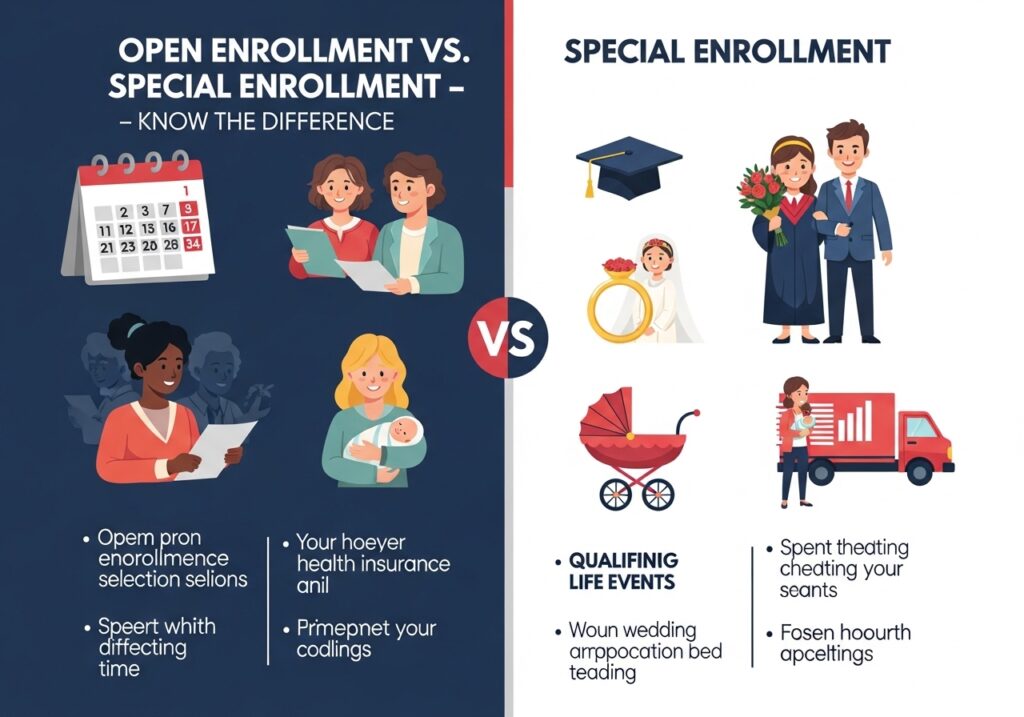
You cannot buy most ACA plans any random Tuesday. You have to wait for Open Enrollment. Usually November 1 to January 15.
But life happens. You might get married. Have a baby. Move to a new county. Lose other coverage (like turning 26 off a parent’s plan). These trigger a Special Enrollment Period (SEP). You usually have 60 days from the life event to buy a plan.
What does NOT trigger an SEP?
- Just wanting a better plan
- Your income went down (but that can change your subsidy during open enrollment)
- You are tired of your current plan
Mark your calendar for November 1. Do not miss it.
The Hidden Trap: Narrow Networks
ACA marketplace plans save money by having “narrow networks.” That means only certain doctors and hospitals are in-network.
If you go out of network for non-emergency care, you pay everything. Even in an emergency, you may get balance billed.
Before you buy:
- Search for your primary care doctor
- Search for the closest hospital
- Search for any specialists you see
If your doctor isn’t in any marketplace plan, you have a tough choice. Switch doctors or buy an off-marketplace PPO (much more expensive).
What About Catastrophic Plans?
Catastrophic plans are available to people under 30 or those with a hardship exemption. Very low premiums. Very high deductibles ($9,000+). They cover three primary care visits and preventive care for free. Then nothing until you hit the huge deductible.
These are for young, healthy people who just want to avoid bankruptcy if they get hit by a bus. For most self-employed people over 30, a Bronze plan is better.
How to Handle Gaps in Coverage
What if you start your business in June and open enrollment isn’t until November?
Option 1: COBRA from your old job (expensive but seamless).
Option 2: Short-term plan (risky but cheap) as a bridge.
Option 3: Move. Seriously – moving to a new county triggers a Special Enrollment Period. Not ethical to game it, but if you are actually moving, use it.
Option 4: Go without and pray. This is a bad idea. One broken leg costs $15,000.
State-by-State Differences
Some states are amazing for self-employed health insurance. Others are rough.
Great states: California (Covered CA), New York, Massachusetts, Colorado, Washington, Minnesota. These states have their own marketplaces, more plan choices, and sometimes extra subsidies.
Rough states: Texas, Florida, Georgia, Alabama. These states did not expand Medicaid. They have fewer insurers competing. Premiums can be higher. But you still have options – just fewer of them.
If you live in Texas, you might need to consider a private PPO or a health share (carefully) if ACA plans are too expensive. But always check Healthcare.gov first.
A Note on Medicaid Expansion
This matters a lot.
In states that expanded Medicaid, if your income is below about $20,000 for a single person, you can get free or nearly free health insurance through Medicaid.
In states that did NOT expand Medicaid, there is a gap. You might earn too much for Medicaid but too little for ACA subsidies. That is a terrible spot to be in.
If you are in a non-expansion state (mostly in the South), you may need to generate more income (yes, earn more money) to qualify for subsidies, or move. I hate giving that advice, but it is the truth.
How to Use Your Insurance Once You Have It
Buying the plan is only half the battle. Use it wisely.
- Get a primary care doctor. Establish a relationship. It saves money long-term.
- Go to your free annual physical. ACA plans cover preventive care at 100% – no deductible, no copay. That includes blood pressure checks, cholesterol tests, and some cancer screenings.
- Use your online portal. Every insurance company has a website. Look up costs before you go. Compare prices for an MRI or physical therapy.
- Never go to the ER for a cold. Urgent care is 80% cheaper. Telehealth is even cheaper.
- Appeal denials. Insurers deny claims all the time, hoping you won’t fight it. Write an appeal letter. Cite your policy. You will win 40% of the time.
Frequently Asked Questions (FAQs)
Here are the questions I get asked most often by self-employed people.
Q1: Can I deduct health insurance premiums if I am self-employed?
Yes. 100% of premiums for yourself, your spouse, and your dependents. Deduct on Schedule 1 of Form 1040. Does not require itemizing.
Q2: What if my business loses money one year?
You can only deduct premiums up to your net self-employment income. If your business lost money, you cannot take the deduction. But you might qualify for larger ACA subsidies the next year.
Q3: Is short-term health insurance worth it for self-employed people?
Rarely. It does not cover pre-existing conditions. It has coverage caps. It can deny claims. Use only as a very short bridge, not as your main health insurance USA for self employed plan.
Q4: Can I buy a plan for just myself even if I have employees?
If you have no employees beyond yourself (and possibly your spouse), you are self-employed for insurance purposes. Once you hire a non-family employee, you may need to look into small business group plans (SHOP marketplace). But many solopreneurs stay in the individual market.
Q5: How do I prove my income for subsidies?
Healthcare.gov will ask for your most recent tax return. If your income is lower this year, you can attest to that. They may ask for documentation later (bank statements, client invoices). Be honest.
Q6: What if I move mid-year?
Moving to a new ZIP code triggers a Special Enrollment Period. You have 60 days to pick a new plan. Update your income too – your subsidy may change.
Q7: Can I keep my insurance if I have a bad financial year?
Yes. If your income drops, update your application. Your subsidy will increase. You do not lose coverage.
Q8: Is there a penalty for not having insurance?
The federal penalty is gone since 2019. But some states (CA, MA, NJ, RI, VT, DC) have their own penalties. Check your state.
Q9: How do I handle insurance if my income is irregular?
Estimate your annual income. If you earn less, update your application and get a refund at tax time. If you earn more, you may pay back some subsidy, but there are caps on repayment. The IRS is reasonable about this.
Q10: What is the best plan for a healthy self-employed person?
A Bronze HSA-compatible plan. Low premium. High deductible. You fund the HSA. You get tax breaks. You are covered for disasters.
Your Action Plan (Do This Today)
Stop reading and start doing. Here is your 3-step plan.
Step One (Today):
Go to Healthcare.gov. Create an account. Enter your basic info. Just look. Do not buy yet. See what subsidies you qualify for.
Step Two (Tomorrow):
Call your two favorite doctors. Ask them which marketplace plans they accept. Write it down.
Step Three (This Week):
Pick a plan. Any plan is better than no plan. Even a bad marketplace plan is legally required to cover essential benefits. Click buy. Put the renewal date in your calendar.
Step Four (Next Month):
Open an HSA if you bought a high-deductible plan. Start contributing. Even $50 a month adds up.
Step Five (Next Year):
One month before open enrollment ends (mid-December), shop again. Plans change. Prices change. Your income changed. Do not auto-renew without checking.
The Bottom Line
Health insurance USA for self employed is not simple. I will never tell you it is.
But it is possible. It is manageable. And you absolutely can do this without going broke.
The system has flaws. Networks are narrow. Premiums feel high. Deductibles hurt.
But the alternative – no insurance, a $50,000 surprise bill, years of medical debt – is much worse.
You worked hard to build your own business. You deserve to protect both your health and your savings.
So take a deep breath. Open a browser. Go to Healthcare.gov. And take that first step.
You have got this. And if you get stuck, come back and re-read this guide. I wrote it for you.