
Let’s be real for a second.
Shopping for home insurance is not fun. It ranks right up there with going to the DMV or cleaning out the gutters in July.
But here is the honest truth. You need it. Your bank probably demands it. And if a tree falls through your living room tomorrow? You will thank your lucky stars you have it.
So, how do you find the perfect policy without spending 40 hours on the phone?
You learn how to Home Insurance Quotes USA – Compare Best Rates like a pro.
I am going to walk you through every single step. No fancy jargon. No robot talking. Just plain English from a friend who wants you to save money and stay safe.
Grab a coffee. Let’s do this.
Why Your Neighbor Might Be Paying Half What You Pay

True story.
My friend Sarah lives two blocks from me. Same size house. Same year built. Same roof material.
She pays $980 a year for home insurance.
I was paying $2,100.
Wait. What?
Yes. For two years, I was getting ripped off simply because I never shopped around. I just let my old policy auto-renew every twelve months like a loyal puppy.
Dogs are loyal. Humans should be smart.
When I finally learned to Home Insurance Quotes USA – Compare Best Rates, I switched companies in one afternoon. I saved $1,120. That is a new dishwasher and a weekend trip to the mountains.
The moral of the story? Prices vary wildly. Different insurers use different math. Some love your credit score. Some love your old plumbing. You never know until you look.
The “Lazy Tax” Is Real
Insurance companies count on laziness. They know most people will not switch. So they slowly creep up your rates every renewal.
Year one: $1,200
Year two: $1,290
Year three: $1,400
And what changed? Nothing. Same house. Same risk. Just a higher bill.
Do not pay the lazy tax.
The moment you decide to Home Insurance Quotes USA – Compare Best Rates, you break that cycle. You become the customer in control. And trust me, that feels good.
What Actually Goes Into Your Home Insurance Quote?
Before you start comparing, you need to understand the ingredients.
Think of your quote like a recipe. Different companies use different amounts of each ingredient. But the basic recipe is the same everywhere.
Let me break it down for you in simple terms.
1. Dwelling Coverage (The Walls and Roof)
This is the big one. It pays to rebuild your house if it burns down or gets flattened by a tornado.
Important note: This is not the same as your home’s market price. A house might sell for $400,000, but rebuilding it might cost $300,000. Or $500,000. It depends on local construction costs.
Do not guess. Do not under-insure. If you insure for too little, you are broke. If you insure for too much, you waste money.
When you Home Insurance Quotes USA – Compare Best Rates, check the dwelling limit on each quote. Make sure they are all using a similar rebuild cost. Otherwise, you are comparing apples to oranges.
2. Personal Property (Your Stuff)
This covers your couch, your TV, your clothes, and your grandma’s china.
Most policies give you coverage equal to 50% to 70% of your dwelling coverage.
Example: Your house is insured for $300,000. Your stuff is likely covered for $150,000 to $210,000.
But here is a catch. High-value items like jewelry, art, or musical instruments often have low limits. A standard policy might only cover $1,500 for stolen jewelry. If you own a $10,000 engagement ring? You need extra coverage.
3. Liability Protection (The “Oops” Coverage)
This is the hidden gem of home insurance. It protects you if someone gets hurt on your property and sues you.
Your neighbor’s kid falls off your trampoline and breaks an arm? Liability covers their medical bills and your legal fees.
Your dog bites the mailman? Liability covers it. (Unless you own a banned breed, but that is another conversation.)
Most experts recommend at least $300,000 in liability. But $500,000 is even better. It costs almost nothing to raise this limit.
4. Loss of Use (A Place to Stay)
If your house burns down and you need to live in a hotel for six months? Loss of use pays for it.
This covers hotel bills, restaurant meals (since you have no kitchen), and even laundry costs.
Trust me, after a disaster, the last thing you want to worry about is money. Good loss of use coverage gives you peace of mind.
5. Deductible (Your Share of the Bill)
The deductible is what you pay before the insurance company pays.
Common deductibles: $500, $1,000, $2,500, or even $5,000.
Higher deductible = lower monthly premium.
Lower deductible = higher monthly premium.
If you have $2,000 in savings, pick a $1,000 or $1,500 deductible. Do not pick a $5,000 deductible unless you actually have $5,000 sitting in the bank. Otherwise, you cannot afford to use your own insurance.
When you Home Insurance Quotes USA – Compare Best Rates, look at the deductible on each quote. A super cheap quote might have a crazy-high deductible that leaves you exposed.
The Secret Sauce – How to Compare Home Insurance Quotes Like a Boss

Okay, now we get to the good stuff. The step-by-step process.
This is how real people save hundreds of dollars without losing their minds.
Step 1 – Gather Your Home Facts First
Do not start calling companies until you have your info ready. You will waste time and get frustrated.
Here is what you need:
- Your home’s address and year built
- Square footage (living area only, not the garage)
- Type of construction (wood frame, brick, stucco)
- Roof type and approximate age (asphalt shingle, metal, tile)
- Heating system (forced air, heat pump, boiler)
- Plumbing and electrical updates (old knob-and-tube wiring? That matters)
- Security system? Fire alarms? Sprinklers?
- Distance to nearest fire hydrant and fire station
- Any recent claims (even small ones)
Write this down on a piece of paper or a note on your phone. Having it ready makes the quoting process five times faster.
Step 2 – Get Quotes from Different Types of Insurers
Here is where most people mess up. They only check one company.
You need variety.
National brands: State Farm, Allstate, Geico (they partner with other insurers), Progressive, Farmers. These are big, stable, and usually easy to work with.
Regional insurers: These are smaller companies that only operate in a few states. They often have lower rates because they know your local area well. Examples include Erie, Auto-Owners, or Amica. (Check if they serve your state.)
Direct-to-consumer: Companies like Lemonade or Hippo. They work entirely online. Super fast. Great for tech-savvy homeowners.
Local independent agents: These folks work with multiple insurance companies at once. They do the shopping for you. You tell them once, and they come back with five to ten quotes.
Make sure you get at least four to six quotes. This is the magic number. When you Home Insurance Quotes USA – Compare Best Rates, four quotes usually reveal the real market price.
Step 3 – Look Beyond the Price Tag
Cheapest is not always best. I know you love a bargain. So do I. But home insurance is different.
Ask yourself these questions for every quote:
- What is the customer service reputation? Check Yelp, Google Reviews, or the Better Business Bureau.
- How fast do they pay claims? Look for phrases like “low complaint ratio” from your state’s insurance department.
- Do they have 24/7 claims support? Fires and floods do not wait for business hours.
- Are there hidden “sinkhole” or “earthquake” exclusions? In some states, you need separate policies for these.
A super cheap company that takes three months to pay a claim is not a bargain. It is a headache you do not need.
Step 4 – Bundle for Big Savings
This is the oldest trick in the book, and it works.
Call your auto insurance company first. Ask them for a home insurance quote. Most will give you a “bundling discount” of 5% to 15% off both policies.
Then do the reverse. Get a home quote and ask about adding your car.
Sometimes bundling beats every other option. Sometimes it does not. You still need to Home Insurance Quotes USA – Compare Best Rates across different bundles.
But definitely check it. I saved 12% just by moving my car and home to the same company.
Step 5 – Ask About Discounts (Seriously, Just Ask)
Insurance companies hide discounts like squirrels hide nuts. You have to ask.
Here are common ones you might qualify for:
- New home buyer discount – First 12 months often cheaper.
- Claims-free discount – No claims in 3–5 years.
- Loyalty discount – Stay with the same company for 3+ years.
- Home safety features – Burglar alarm, smoke detectors, deadbolts.
- Smart home devices – Leak detectors, smart thermostats, security cameras.
- Gated community – Less risk of theft.
- Senior discount – If you are retired and home more often.
- Paid-in-full discount – Pay the whole year upfront.
- Paperless discount – Go green, save five bucks.
- Auto-pay discount – Set it and forget it.
When you call for quotes, literally say: “What discounts do you offer? Please list every single one.”
Then go down the list. Check every box you qualify for.
Common Mistakes People Make When Shopping for Home Insurance
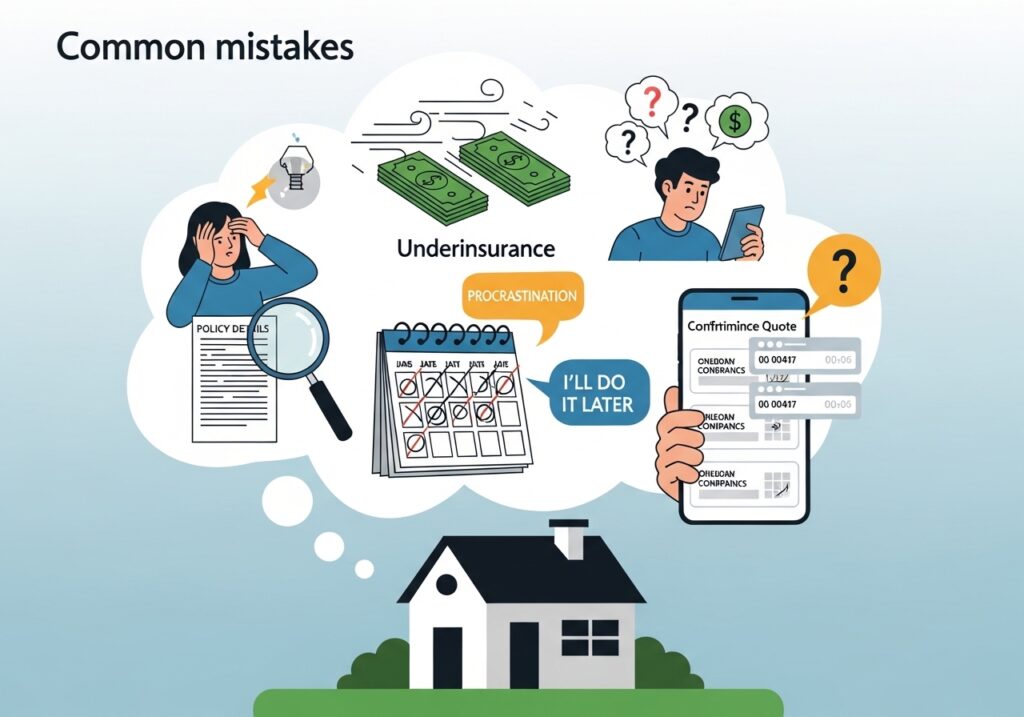
I see these same errors again and again. Do not be that person.
Let me save you the pain.
Mistake #1 – Only Comparing Price Per Month
Low monthly payments look sexy. But look at the big picture.
A policy might show $120 per month. Sweet, right? But it has a $5,000 deductible and no loss of use coverage. Another policy shows $150 per month with a $1,000 deductible and full replacement cost.
The second one is actually better. You just have to do the math.
Mistake #2 – Forgetting About Actual Cash Value vs. Replacement Cost
This one is huge. Pay attention.
Actual Cash Value (ACV) = What your stuff is worth today after depreciation.
Example: Your five-year-old laptop cost $1,000 new. Today, it is worth maybe $200. ACV pays you $200.
Replacement Cost Value (RCV) = What it costs to buy a new one.
Same laptop. RCV pays you $1,000 to go to Best Buy and get a new one.
Home insurance with RCV costs a bit more. But it is worth every penny. When you Home Insurance Quotes USA – Compare Best Rates, always check if the quote uses RCV for personal property.
Mistake #3 – Lying on Your Application
I get it. You want a lower rate. So you say your roof is 8 years old when it is really 15 years old.
Bad idea.
Insurance companies send inspectors. They use satellite photos. They will find out.
And if you file a claim and they discover you lied? They can deny your claim and cancel your policy. Then you have a “cancelled for misrepresentation” on your record. Good luck getting affordable insurance after that.
Just be honest. It is not worth the risk.
Mistake #4 – Ignoring the Credit Score Factor
In most states, your credit score affects your home insurance rate.
Studies show people with better credit file fewer claims. So insurers charge less.
If your credit is rough, work on improving it. Pay down debt. Pay bills on time. Even a 30-point increase can save you 5% to 10% on your premium.
But if your credit is poor right now? Some companies focus less on credit. Ask independent agents to find those insurers for you.
Mistake #5 – Not Re-Shoping Every Year
You did the work. You found a great rate. You are done forever, right?
No.
Do this every 12 months. Set a calendar reminder right now for one year from today. Call it “Insurance Shopping Day.”
Rates change. New companies enter your area. Your own situation changes (new roof, new security system, teenager moves out).
Make it a habit to Home Insurance Quotes USA – Compare Best Rates annually. It takes two hours. It can save you $500 or more. That is a better hourly rate than your day job.
Real-Life Examples – How Different Homes Get Different Quotes
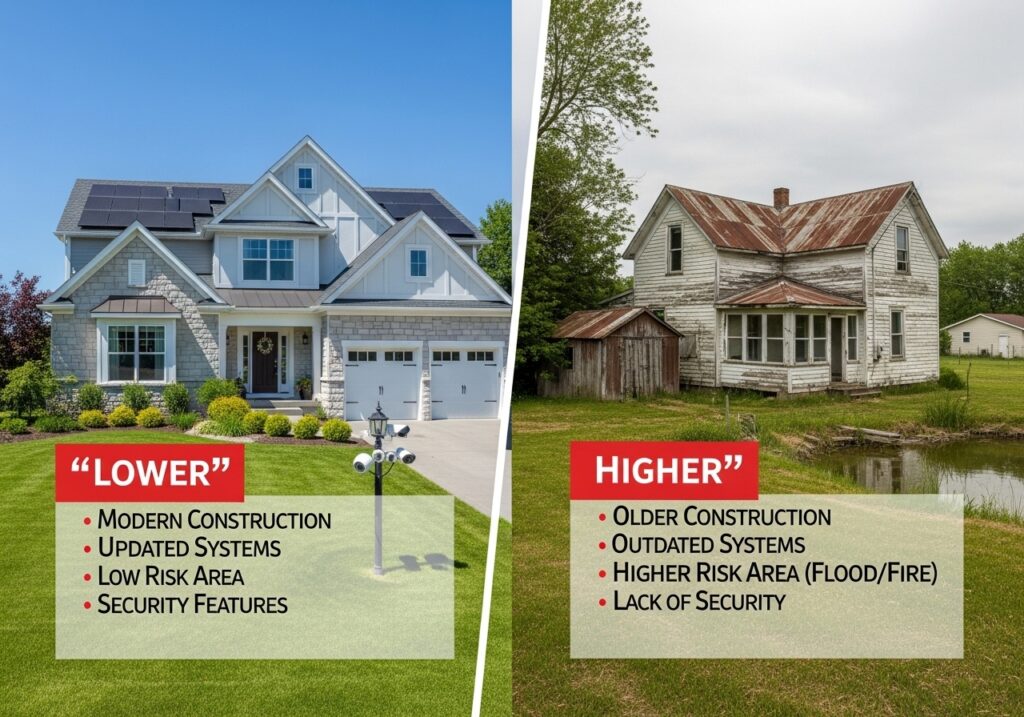
Let me walk you through three real examples. These are based on actual quotes from 2024 and 2025.
Example 1 – The Suburban Family Home
The home: 2,200 square feet. Built in 2005. Brick exterior. Asphalt shingle roof replaced in 2019. Suburban neighborhood. Good schools. Low crime.
The quotes:
- Big National Brand A: $1,450/year ($1,000 deductible, RCV on personal property)
- Big National Brand B: $1,680/year ($1,000 deductible, includes $500,000 liability)
- Regional Insurer C: $1,240/year ($1,000 deductible, loss of use coverage at 50% of dwelling)
- Online Insurer D: $1,100/year ($2,500 deductible, ACV on personal property – not good)
Best pick: Regional Insurer C at $1,240 with RCV. Good price. Good coverage. No trick deductibles.
Example 2 – The Older Fixer-Upper
The home: 1,500 square feet. Built in 1970. Original wiring but updated panel. Copper plumbing. Roof is 18 years old. Sits farther from fire hydrant.
The quotes:
- National Brand A: $2,400/year (they worry about old wiring and roof)
- Regional Insurer E: $1,950/year (specializes in older homes)
- Surplus Lines Insurer: $3,100/year (because normal insurers declined)
- Local Mutual Company: $2,100/year (requires membership but good service)
Best pick: Regional Insurer E. But only after they replace that old roof. The homeowner got a new roof for $7,500 and the quote dropped to $1,450. Do the upgrades first if you can.
Example 3 – The Coastal Condo
The home: Condo, 1,200 square feet. Built in 2015. Hurricane zone. Windstorm risk is high.
The quotes:
- National Brand A: $950/year (walls-in coverage only, HOA master policy covers building)
- Specialized Wind Insurer: $1,200/year (for hurricane deductible of 2%)
- Bundle with Auto: $890/year (same walls-in coverage)
Best pick: Bundle with Auto at $890. But read the HOA master policy first. Make sure you are not doubling up or missing coverage gaps.
Notice how different each situation is? That is why you must Home Insurance Quotes USA – Compare Best Rates for your unique home. Do not copy your neighbor.
How to Read the Fine Print (Without Falling Asleep)
The fine print stinks. Nobody likes reading legal documents.
But you can skim for the dangerous stuff.
Look for these words and phrases:
- “Actual cash value” – Run away unless you understand the risk.
- “Ordinance or law exclusion” – This means if you have to rebuild to meet new building codes, they do not pay the extra cost. You want at least 10% to 25% ordinance coverage.
- “Water backup excluded” – Sewer backs up into your basement? Not covered unless you add an endorsement (usually $40–$80 extra per year).
- “Mold exclusion” – Most policies limit mold to $5,000 or $10,000. If you live in a humid area, ask for more.
- “Animal liability exclusion” – Some policies exclude certain dog breeds or exotic pets.
When you Home Insurance Quotes USA – Compare Best Rates, lay the policies side by side. Compare these exclusions. A cheap policy with a mold exclusion could cost you $20,000 out of pocket later.
How to Lower Your Home Insurance Quote Right Now
Want to see your numbers drop without switching companies?
Try these practical moves.
Raise Your Deductible (But Keep It Reasonable)
Going from a $500 deductible to a $1,000 deductible often cuts your premium by 10% to 15%.
Go from $1,000 to $2,500? Another 10% to 15% usually.
Just make sure you have the cash set aside.
Improve Your Home’s Risk Factors
- New roof: Shingles have a lifespan. Old roofs cost more to insure. A new roof can save you up to 20% on your premium.
- Updated wiring: Replacing old knob-and-tube or aluminum wiring is a big win. Insurers love modern copper or updated electrical.
- New plumbing: Old galvanized pipes or polybutylene pipes? Replace them. Tell your insurer. Watch your rate drop.
- HVAC updates: New furnace or AC unit? Not as big a deal as roof or wiring, but worth mentioning.
- Security system: Monitored alarm? Even a simple Ring or SimpliSafe system can get you a discount.
Stop Making Small Claims
Here is a hard truth. Never file a small claim.
If your fence blows over and repairs cost $1,200? Pay it yourself.
Why? Because one small claim can raise your rate for three to five years. That increase might cost you $2,000 or more over time.
Save home insurance for big stuff: fire, theft, major storm damage, liability lawsuits.
When you Home Insurance Quotes USA – Compare Best Rates, insurers ask about your claim history. Zero claims in five years gets you the best rate.
Frequently Asked Questions (Real Questions from Real Homeowners)
I collected these from real conversations. Real people ask these all the time.
Q1: How many quotes should I get before buying?
Get at least four. Six is better. When you Home Insurance Quotes USA – Compare Best Rates, four quotes usually show you the range. Six locks in the best deal.
Q2: Can I get a home insurance quote without a phone call?
Yes. Many companies offer online quoting. Lemonade, Hippo, Geico, and Progressive all have instant online tools. But for the best rates, one 10-minute phone call with an independent agent is worth it.
Q3: Why did my quote go up when I bought the house?
Because the previous owner had a policy from years ago. When you apply as a new customer, you get today’s rates. And rates go up every year due to inflation, more storms, and higher construction costs.
Q4: Does having a pool or trampoline raise my rate?
Yes. Both are “attractive nuisances.” They increase liability risk. A trampoline might raise your rate 5% to 10%. Some companies will outright refuse you. Always disclose these. If you lie and your neighbor’s kid gets hurt, your claim could be denied.
Q5: How does my dog affect my home insurance?
Some breeds (Pit Bulls, Rottweilers, German Shepherds, Dobermans) are on “restricted lists.” Some insurers will exclude liability for the dog. Some will decline you entirely. Others do not ask.
If you own a restricted breed, shop with companies like State Farm or Chubb (they are more dog-friendly). Or get a separate umbrella liability policy.
Q6: What is not covered by a standard home insurance policy?
Standard policies exclude:
- Floods (need separate flood insurance from FEMA or private insurers)
- Earthquakes (need separate endorsement or policy)
- Normal wear and tear (maintenance is on you)
- Pest infestations (termites, bed bugs, rodents)
- Mold (limited or excluded without extra endorsement)
- Sewer backup (limited or excluded without extra endorsement)
Read your exclusions! When you Home Insurance Quotes USA – Compare Best Rates, ask each agent about flood and earthquake if you live in a risk zone.
Q7: How soon can I get coverage after getting a quote?
Often the same day. Many policies start at 12:01 AM the day after you apply. Some let you choose a future date (like your closing date when buying a house).
Q8: Why did my friend get a quote for $800 and mine is $2,000?
Different homes, different risks. Compare these factors:
- Your friend’s house is newer.
- Their roof is three years old; yours is 20 years old.
- They have a fire station two blocks away; you are four miles away.
- Their credit score is 780; yours is 620.
- They have never filed a claim; you filed two claims in three years.
Comparison is natural. But focus on your own situation. You can only improve what you control.
The Best Time of Year to Shop for Home Insurance
There is a secret calendar trick.
Insurance rates change throughout the year. Here is when to strike.
Late winter (January–February): Slow season for home purchases and moves. Insurers lower rates to attract business. Good time to shop.
Spring (March–May): Busy season. People buy homes, move, and switch policies. Rates tend to be stable or slightly higher.
Summer (June–August): Hurricane and wildfire season heat up. If you live in a coastal or fire-prone area, rates might be higher. Insurers are nervous.
Fall (September–November): After hurricane season, but before winter storms. A sweet spot for many regions. Rates sometimes dip.
Best tip: Shop at least 30 days before your policy renewal date. You have time to compare. You are not rushed. And you can tell your current company, “Match this or I walk.”
When you Home Insurance Quotes USA – Compare Best Rates during off-peak months, insurance companies are hungrier for your business.
How to Switch Home Insurance Companies Without a Gap in Coverage
This scares a lot of people. They worry about being uninsured for even one day.
Do not worry. It is easy.
Step 1: Get your new policy start date. Choose a date that is the same as your old policy’s end date or one day before.
Step 2: Call your old company. Tell them you are not renewing. Do this in writing too (email is fine). Ask them to confirm in writing.
Step 3: Make sure your new company has your mortgage company’s info. They will send the new policy documents directly to the bank.
Step 4: Overlap by one day if you are nervous. Have the new policy start on the 14th and the old policy end on the 15th. You pay for one day of double coverage. That costs maybe $2–$5. Cheap peace of mind.
Step 5: Cancel any automatic payments for the old policy. Do not assume they will stop billing you.
That is it. You are switched. No gap. No stress.
Conclusion – Your Action Plan for Today
Alright, friend. You made it to the end. That is more than most people do.
Now it is time to act. Do not let this article sit in a browser tab for three months.
Here is your simple four-step action plan:
Step 1 (15 minutes): Gather your home facts. Write down the square footage, roof age, wiring type, and any safety features.
Step 2 (1 hour): Get four to six quotes. Use one online tool (like Gabi or Policygenius), call two national brands, and call one local independent agent.
Step 3 (30 minutes): Compare the quotes side by side. Look at deductible, dwelling limit, personal property replacement cost, liability limit, and exclusions. Do not just look at the monthly price.
Step 4 (10 minutes): Pick the best value, not just the cheapest. Then make the switch. Set a calendar reminder for 11 months from now to do it all over again.
When you Home Insurance Quotes USA – Compare Best Rates the right way, you are not being cheap. You are being smart. You are protecting your family, your home, and your bank account.
You work hard for your money. Do not hand extra to an insurance company just because you were too busy to shop around.
Go get those quotes. Save that cash. And sleep better tonight knowing you did the right thing.
You have got this.