
If you’re starting a business in the United States, you’ve probably heard the phrase “business insurance USA requirements” thrown around. But let’s be real most explanations sound like they were written by a robot with a law degree. Confusing terms. Gray areas. Lots of “it depends.”
I’m here to fix that.
Think of me as your friend who happens to know way too much about small business risk. I’ll walk you through what’s legally required, what’s just smart to have, and what you can safely skip. No legalese. No scare tactics. Just real talk.
By the end of this post, you’ll know exactly how to protect your business without overpaying or missing something critical. Let’s dive in.
Business Insurance USA Requirements.

Is Business Insurance Required by Law in the USA?
Short answer: Sometimes yes, sometimes no.
There is no federal law that says “every business must buy insurance.” Uncle Sam doesn’t send you a letter on day one. But here’s where it gets tricky—states, cities, landlords, and clients can all force your hand.
Let me give you three real scenarios.
Scenario A: You work from home selling handmade candles online. No employees. No storefront. No company car. In this case, no state law requires you to have insurance. But your homeowner’s policy probably won’t cover business liability. If a candle catches someone’s house on fire, you’re on the hook personally.
Scenario B: You own a small bakery with three employees. Now we’re talking. Most states require workers’ compensation once you hire staff. Your lease might demand general liability. And the health department could ask for product liability proof.
Scenario C: You drive for a delivery service using your own car. Your personal auto policy won’t cover commercial use. Most states require commercial auto insurance if you transport goods for money.
See how different it gets?
So when people ask “what are the business insurance USA requirements?”—the honest answer is: it depends on your specific situation.
But don’t worry. I’ll help you figure out yours.
The 5 Types of Business Insurance That Are Often Required (By State or Contract)
Let’s get specific. Here are the most common types of coverage that either the law or a contract will force you to carry.
Workers’ Compensation Insurance
This is the big one.
Legally required in almost every state if you have employees. Even one part-time employee. Even a family member you pay.
Only a few states (like Texas) let you skip it under certain conditions. But most states are strict. You can face fines, jail time, or both for operating without workers’ comp.
What it does: Pays medical bills and lost wages if an employee gets hurt at work.
Who needs it: Any business with W-2 employees. In some states, even subcontractors must be covered.
Real example: A delivery driver slips on a wet floor at your warehouse. Workers’ comp covers his ER visit and two weeks of missed work.
States with unique rules: Ohio, North Dakota, Washington, Wyoming – you must buy from a state fund. No private insurers. Texas – no state requirement, but good luck getting contracts without it.
Commercial Auto Insurance
If you use a vehicle for work, your personal policy won’t cut it.
Legally required in every state for vehicles owned by your business. Even if it’s just one van. Even if you only drive it on weekends.
What it does: Covers accidents, injuries, and property damage when you’re driving for work.
Who needs it: Anyone with a company-owned vehicle. Also anyone who uses their personal car for deliveries, client visits, or hauling equipment (though laws vary here).
Real example: You’re a plumber driving your personal truck to a client’s house. You rear-end someone. Without commercial coverage, your personal insurer can deny the claim. You pay out of pocket.
Minimum liability limits vary by state. California requires $15,000 per person / $30,000 per accident. Texas requires $30,000 / $60,000. Check your state’s Department of Motor Vehicles website.
General Liability Insurance (Not Always Required by Law, But Often by Contracts)
Here’s where things get interesting.
Most states don’t legally require general liability. But your landlord, your client, or your vendor might.
What it does: Covers third-party injuries, property damage, and advertising injury (like accidentally suing someone for libel).
Who needs it: Any business that interacts with the public, rents a physical space, or signs contracts.
Real example: A customer trips over a frayed rug in your retail store. She breaks her wrist. General liability pays her medical bills and her lawsuit if she sues.
Many commercial leases require $1 million in general liability. Many client contracts do too. So while it’s not a state requirement, it becomes a practical requirement very quickly.
Professional Liability (Errors & Omissions)
Also rarely required by state law. But your industry board or your biggest client might demand it.
What it does: Covers mistakes, oversights, or negligence in your professional advice or service.
Who needs it: Accountants, consultants, real estate agents, IT professionals, architects, doctors, lawyers—anyone giving advice or providing a service for a fee.
Real example: You’re an IT consultant. You install the wrong security patch, and your client gets hacked. They sue you for $250,000. Professional liability covers your legal defense and settlement.
Some states require certain professionals to carry E&O. For example, California requires real estate agents to have it. But for most businesses, it’s driven by contracts.
Surety Bonds (For Licensed Trades)
This one confuses people. A bond isn’t exactly insurance. But it functions like one.
Legally required for many licensed trades: contractors, auto dealers, travel agents, mortgage brokers, and more.
What it does: A bond guarantees you’ll follow the law. If you don’t, the bond pays affected customers, and then you repay the bond company.
Who needs it: Any business that requires a state or local license to operate.
Real example: You’re a general contractor in Florida. The state requires a $20,000 surety bond. A customer pays you $10,000 for a kitchen remodel. You disappear with the money. The bond pays the customer, and then the bond company comes after you for the full amount plus fees.
Business Insurance Requirements by State – A Quick Cheat Sheet
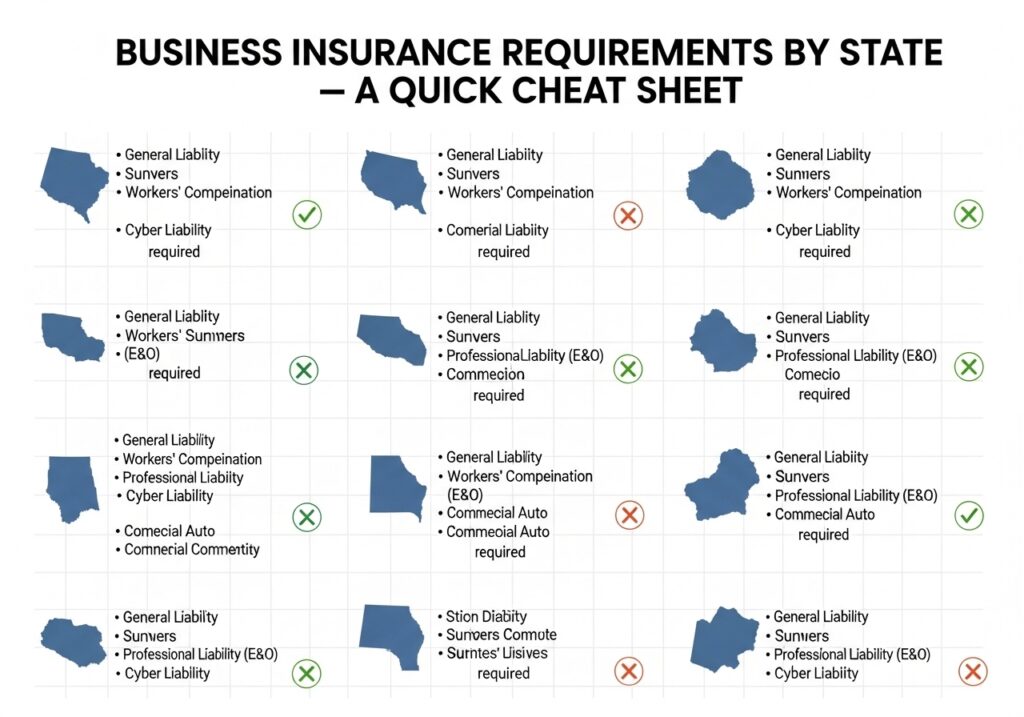
Let me save you hours of Googling. Here are the most notable state-by-state differences for business insurance USA requirements.
California
Workers’ comp required for all employees, even part-time. Commercial auto required for business vehicles. No state general liability requirement, but leases and contracts often require it. Real estate agents need E&O.
Texas
Workers’ comp is not required by state law. But if you don’t have it, you lose certain legal defenses if an employee sues. Commercial auto required. Contractor licenses often require general liability and a surety bond.
New York
Workers’ comp required (very strict enforcement – fines can reach $2,500 per 10-day period). Disability benefits insurance required if you have one or more employees. Commercial auto required.
Florida
Workers’ comp required for construction businesses with even one employee. For non-construction, four or more employees triggers the requirement. Contractor licenses require general liability and a bond. Commercial auto required.
Ohio
Workers’ comp must be bought through the state’s monopoly fund (Ohio BWC). Commercial auto required.
North Carolina
Workers’ comp required for three or more employees. Commercial auto required. No state general liability requirement, but many service contracts require it.
Pro tip: Your state’s Department of Labor or Workers’ Compensation Commission website is the final authority. Don’t trust blog posts alone. But this list gives you a solid starting point.
What About Sole Proprietors and Freelancers? Do You Need Insurance?
This is where most online guides get lazy. They say “sole proprietors don’t need anything.” That’s technically true but practically dangerous.
Here’s the raw truth: No state requires a sole proprietor to carry general liability or professional liability. But that doesn’t mean you should skip it.
Let me explain with two stories.
Story one – Sarah, freelance graphic designer. No employees. Works from home. She thinks she doesn’t need insurance. One day she misses a deadline for a client’s billboard campaign. The client loses $40,000 in ad revenue. They sue Sarah personally. Her home, her savings, her car – all at risk. A $500 professional liability policy would have covered her.
Story two – Tom, landscaper. Sole proprietor. No employees. He’s mowing a lawn and a rock flies through a neighbor’s window. The neighbor wants $3,000 for replacement. Tom pays it out of pocket because he has no general liability. That’s three weeks of profit gone.
So while business insurance USA requirements for sole proprietors are almost nonexistent, the financial risks are very real.
What sole proprietors should consider:
- General liability (for client property damage or injuries)
- Professional liability (for service-based mistakes)
- Commercial auto (if you drive for work)
- Inland marine (for equipment you take to job sites)
Don’t hide behind “it’s not required.” Protect yourself.
Business Insurance Requirements for Home-Based Businesses
Here’s a trap I see all the time.
You work from home. You assume your homeowner’s policy covers your business. It doesn’t.
Most homeowner’s policies exclude business liability. They also limit business personal property to $2,500 or less. That means your $5,000 laptop, your inventory, your client files – not covered.
What’s actually required:
- If you have employees working in your home, workers’ comp is required (same rules apply).
- If you have clients visiting your home, your homeowner’s policy won’t cover their injuries. You need a business liability endorsement or a separate general liability policy.
- If you have inventory, you need business property coverage.
The smart move: Ask your home insurer about a “home-based business endorsement.” For many small operations, it adds $100–$200 per year and plugs the biggest gaps.
But if you have regular client visits, employees, or expensive equipment, buy a separate Business Owners Policy (BOP). We’ll talk about BOPs in a minute.
What Happens If You Don’t Meet Business Insurance USA Requirements?
Let’s get real about consequences. Because “you could get in trouble” isn’t specific enough.
For workers’ compensation violations:
- Fines from $500 to $10,000+ per violation (depending on state)
- Jail time in extreme cases (yes, really – some states have criminal penalties)
- Stop-work orders – the state shuts you down until you comply
- Personal liability for workplace injuries – you pay medical bills out of pocket
For commercial auto violations:
- Traffic tickets (driving without insurance is illegal in every state)
- License suspension
- Personal liability for any accident – you could lose your house
For contract violations (general liability or professional liability):
- Breach of contract lawsuits
- Loss of major clients
- Inability to renew leases or sign new deals
Real example: A small cleaning company in New York skipped workers’ comp for three part-time employees. One employee fell off a ladder. The state audited the company. Fines totaled $34,000. The owner had to sell his work van to pay them.
Don’t be that person. Following business insurance USA requirements is usually cheaper than the penalties.
How to Find Out Exactly What Insurance Your Business Needs
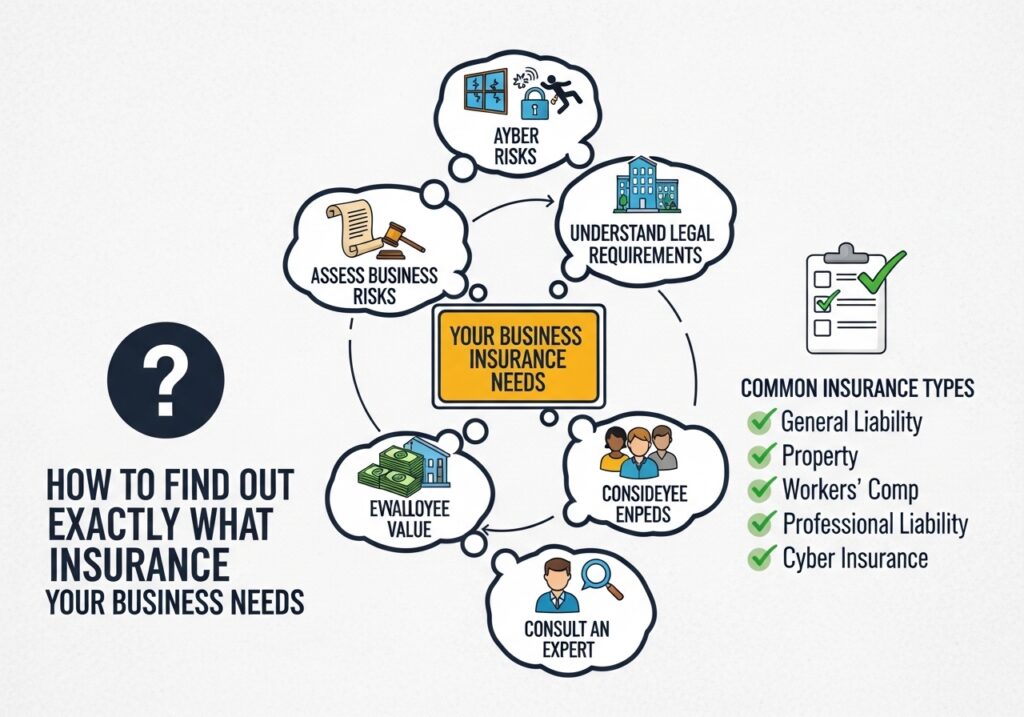
By now you’ve realized there’s no one-size-fits-all answer. But here’s a step-by-step method to figure out your exact requirements.
Step 1: Check your state’s workers’ comp rules
Google: “[Your state] workers’ compensation requirements”
Look for the official .gov website. Make a note of:
- Minimum number of employees that trigger the requirement
- Whether sole proprietors and partners can exclude themselves
- Penalty structure for non-compliance
Step 2: Check your lease if you rent commercial space
Pull out your lease agreement. Look for sections titled “Insurance” or “Indemnification.” Most commercial leases require general liability of $1 million. Some also require property insurance, business interruption, and even workers’ comp evidence.
Step 3: Review your client contracts
Do any of your contracts require you to carry certain coverage? I’ve seen contracts require everything from $2 million in general liability to cyber liability to employment practices liability. If it’s in the contract, it’s effectively required.
Step 4: Check your professional license requirements
Google: “[Your profession] license requirements [your state]”
For example: “contractor license requirements Florida”
Many licenses post their bond and insurance requirements right on the application page.
Step 5: Talk to a licensed commercial insurance agent
This is the most important step. A good independent agent works for you, not for a single insurance company. They’ll:
- Review your specific risks
- Tell you exactly what’s required by law vs. contract
- Shop multiple carriers to save you money
- Bundle coverages into a Business Owners Policy (BOP) for discounts
Avoid online-only quotes for complex businesses. There’s no substitute for a human who understands your local laws.
What Is a Business Owners Policy (BOP) and Do You Need One?
A BOP is like a value meal for small business insurance. It bundles:
- General liability
- Commercial property (for your building or contents)
- Business interruption (income loss from a covered event)
Why small business owners love BOPs: They’re cheaper than buying each policy separately – usually 10–20% cheaper. And they’re easier to manage because everything’s in one package.
Who qualifies for a BOP: Typically businesses with fewer than 100 employees, under $5 million in annual revenue, and low-to-medium risk. Think retail stores, offices, restaurants, small manufacturers, contractors.
Real example: A coffee shop owner buys a BOP for $1,200 per year. It covers $500,000 in general liability, $100,000 in property (espresso machine, furniture, inventory), and $50,000 in business interruption. A pipe bursts, flooding the shop. The BOP covers repairs, replaces ruined inventory, and pays lost income during the 2-week closure.
Following business insurance USA requirements often means a BOP is your most cost-effective option.
Special Industry Requirements You Should Know About
Some industries have unique requirements baked into state or federal law. Let me highlight a few.
Construction and Contractors
- Almost always require workers’ comp (even for sole proprietors in some states)
- General liability is required for most licenses
- Surety bonds for certain contract values
- Commercial auto for work trucks
- Inland marine for tools and equipment
Healthcare and Wellness
- Professional liability (malpractice) required for licensure in most states
- Cyber liability often required by HIPAA (for data breaches)
- General liability for patient injuries
Transportation and Delivery
- Commercial auto required by law
- Cargo insurance often required by shippers
- General liability for loading/unloading injuries
Retail and Hospitality
- General liability required by most leases
- Liquor liability for bars and restaurants (required in many states)
- Workers’ comp for all staff
Technology and IT
- Professional liability (E&O) required by client contracts
- Cyber liability often required by data protection laws
- General liability for on-site visits
Bottom line: Google “[your industry] insurance requirements [your state]” before you buy anything. Industry associations also publish great free guides.
7 Common Myths About Business Insurance USA Requirements
Let me bust some myths before you make an expensive mistake.
Myth 1: “My LLC protects my personal assets, so I don’t need liability insurance.”
False. An LLC protects you from some lawsuits, but not from everything. It won’t protect you from your own negligence. If you personally cause an injury or damage, someone can still sue you directly. GL insurance covers that gap.
Myth 2: “Workers’ comp is optional for part-time employees.”
False. In most states, part-time, seasonal, and temporary employees count toward your employee total. One hour a week still triggers the requirement.
Myth 3: “My personal umbrella policy covers my business.”
False. Personal umbrella policies explicitly exclude business activities. Some have limited coverage for incidental business (like selling a few items on Etsy), but most don’t.
Myth 4: “General liability covers employee injuries.”
False. That’s what workers’ comp is for. GL specifically excludes employee injuries. Don’t mix them up.
Myth 5: “I don’t need insurance until I get sued.”
False. Insurance doesn’t cover claims that happened before your policy started (called “prior acts” coverage). Buy before you need it.
Myth 6: “My subcontractors’ insurance covers me.”
False. If a subcontractor works for you and doesn’t have insurance, you can be held responsible for their mistakes. Always ask for certificates of insurance from subs.
Myth 7: “The cheapest policy is fine.”
False. Cheap policies often have low limits, high deductibles, and aggressive exclusions. Pay a little more for a carrier with an A rating from AM Best and clear coverage terms.
FAQs About Business Insurance USA Requirements
Let me answer the questions I hear most often from business owners like you.
Can I skip workers’ comp if all my employees are family members?
In most states, no. Family members who are W-2 employees count. A few states exempt spouses and children under a certain age, but never assume. Check your state’s rules.
What’s the penalty for not having required insurance?
It varies wildly. For workers’ comp, fines can range from $100 per day in some states to $10,000 per violation in others. Some states also impose stop-work orders. For commercial auto, you’re looking at tickets, license suspension, and personal liability for accidents.
Do I need insurance if I work from home with no employees?
Technically no state requires it. But your homeowner’s policy won’t cover business claims. So while it’s not a legal requirement, it’s often a smart financial move.
How much general liability insurance do I need?
Most small businesses carry $1 million per occurrence / $2 million aggregate. Many leases and contracts require those exact numbers. If you have significant assets or high-risk work, consider $2 million/$4 million.
Does business insurance cover cyber attacks?
Not under standard general liability. You need separate cyber liability insurance. Some BOPs offer cyber as an add-on. Given how common data breaches are, most businesses with customer data should consider it.
Can I buy business insurance online instantly?
For simple policies like general liability, yes. For workers’ comp, commercial auto, or complex risks, you’ll likely need to talk to an agent. Don’t trust the instant quote until a human reviews it.
How often should I review my business insurance?
At least once a year, or whenever something major changes: new employees, new equipment, new location, new services, or new contracts.
What’s the difference between “claims-made” and “occurrence” policies?
Occurrence policies cover incidents that happen during your policy period, no matter when you file the claim. Claims-made policies require the claim to be filed while the policy is active. For most small businesses, occurrence is simpler and safer.
How to Save Money on Business Insurance (Without Skimping on Coverage)
I promised no scare tactics, and I also promised no financial waste. Here’s how to pay less for the coverage you actually need.
1. Bundle into a BOP when possible.
Buying general liability, property, and business interruption together usually saves 10–20%.
2. Raise your deductible.
Going from $500 to $1,000 or $2,500 can lower your premium significantly. Just make sure you have the cash set aside.
3. Pay annually instead of monthly.
Many carriers charge fees for monthly payments. Paying upfront can save 5–10%.
4. Ask about industry-specific discounts.
Some carriers give discounts for safety training, security systems, sprinklers, or membership in industry associations.
5. Shop around every 2–3 years.
Don’t auto-renew forever. Get quotes from 3–5 independent agents to compare. Loyalty rarely saves you money in insurance.
6. Implement risk management.
Document safety protocols. Train employees regularly. Keep a clean claims history. Carriers love businesses that actively reduce risk.
7. Consider a pay-as-you-go workers’ comp policy.
If your payroll fluctuates seasonally, pay-as-you-go policies based on actual payroll (not estimated) can save thousands.
Real example: A small landscaping company switched from a standard workers’ comp policy to a pay-as-you-go plan. They saved $4,200 the first year because their winter payroll was much lower than their summer estimate.
A Simple Action Plan to Meet Your Business Insurance USA Requirements
Let’s turn all this information into action. Here’s exactly what to do this week.
Day 1: Audit your current situation.
- List all employees (including part-time and seasonal)
- List all vehicles used for work (owned or personal)
- List all client contracts with insurance requirements
- Find your commercial lease if you have one
- Find your professional license if you have one
Day 2: Research state requirements.
- Google workers’ comp rules for your state
- Google commercial auto minimum limits
- Google professional liability requirements for your license
Day 3: Call an independent agent.
- Find 2–3 independent agencies (trustedchoice.com is a good directory)
- Give them your list from Day 1
- Ask specifically: “What is legally required vs. what do you recommend?”
Day 4: Compare quotes and coverage.
- Don’t just compare price. Compare limits, deductibles, and exclusions.
- Check carrier ratings on AM Best (A- or better is ideal)
- Look for hidden fees (some charge policy issuance fees, inspection fees, etc.)
Day 5: Buy and document.
- Purchase the required policies first (workers’ comp, commercial auto)
- Buy recommended coverage if budget allows
- Store certificates of insurance digitally and physically
- Send certificates to landlords and clients who requested them
Day 6: Set a calendar reminder.
- Put a review date on your calendar 10 months from now
- Also note your policy renewal dates in your calendar (usually 30 days before)
That’s it. Six days of intentional work, and you’re protected.
Don’t Fear the Requirements, Just Handle Them
Here’s what I want you to remember.
Business insurance USA requirements sound intimidating. They sound like red tape designed to frustrate you. But most of them exist for a good reason – to protect you, your employees, and your customers from financial disaster.
The key is to stop guessing and start verifying.
Check your state laws. Review your contracts. Talk to an independent agent who speaks plain English. Then buy only what you need – no more, no less.
You started your business to build something meaningful, not to lie awake worrying about “what if.” Insurance is just a tool. Use it properly, and it fades into the background where it belongs.
So take that first step today. Audit your current situation. Make one phone call. You’ll sleep better tomorrow, I promise.
And if you found this guide helpful? Share it with another business owner who’s currently confused and stressed about insurance. We’re all in this together.