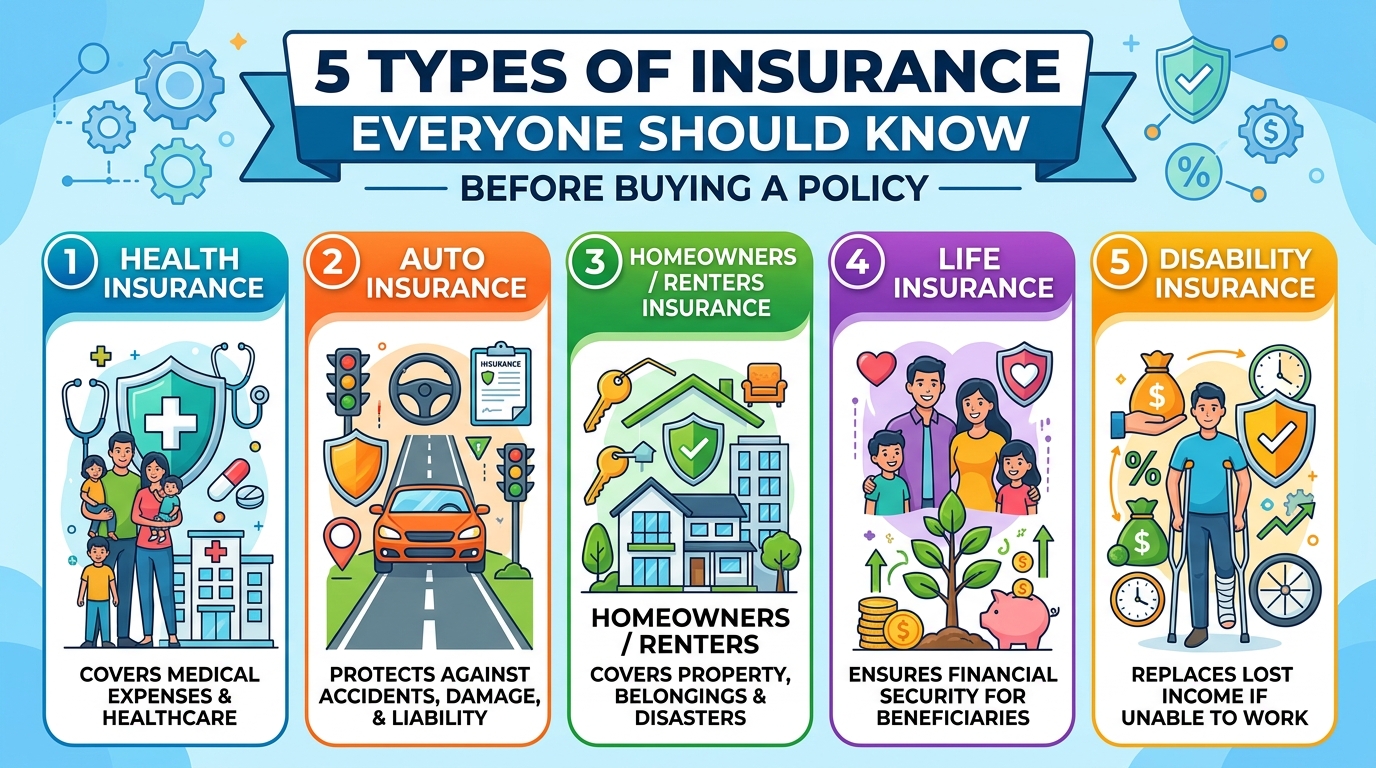
5 Types of Insurance Policy Everyone Should Know Before Buying a Policy
New to insurance Policy? Don’t buy a policy blind. Discover the 5 essential types of Insurance Policy everyone needs to know, with practical tips to save money and avoid common pitfalls.
Let me tell you a quick story about my neighbor, Tom.
Tom is a smart guy. He runs his own business, keeps his lawn immaculate, and even does his own car repairs. But last year, a random tree branch fell on his roof during a storm. He figured, “No problem, I have homeowners Insurance Policy.” But when he called his agent, he got the shock of his life. The damage wasn’t fully covered because he had no idea what his policy actually included.
Tom learned a hard lesson that day. Insurance Policy isn’t something you buy and forget about. It’s something you need to understand—at least a little bit—before you need it.
If you are new to the world of premiums, deductibles, and coverage limits, don’t worry. You are not alone. Most of us just pick a plan because it sounds cheap or because our friend recommended it. But here is the truth: picking the wrong Insurance Policy can cost you way more than you save.
I have spent years helping friends and family navigate this stuff, and today, I am going to walk you through the five types of Insurance Policy that every single person should know about. By the time you finish reading this, you will know exactly what to look for and what questions to ask.
Let’s get started.
Health Insurance Policy: Your First Line of Defense

If there is one type of Insurance Policy you cannot skip, it is health insurance. I don’t care how young or healthy you are. A single accident or sudden illness can turn your financial world upside down faster than you can imagine.
Think about it this way. You pay a monthly premium, which might feel annoying, especially when you are healthy. But that premium is like a membership fee. It keeps you in the club so that when something bad happens, the club pays the big bills.
Why You Can’t Afford to Skip It
Let me paint you a picture. Sarah is 28 years old. She runs every morning and eats kale salads for lunch. She decides she doesn’t need health insurance because she never gets sick. Then one evening, she trips on the stairs at a movie theater and breaks her ankle.
The emergency room visit, the X-rays, the consultation with a specialist, and the surgery to put a pin in that ankle? We are talking tens of thousands of dollars. Without insurance, Sarah is now drowning in debt. With Insurance Policy, she might pay a few thousand for her deductible, and the rest is covered.
Health Insurance Policy is not about paying for your daily needs. It is about protecting your savings from the “what ifs.”
The Main Parts You Need to Understand
When you look at a health Insurance Policy plan, you will see a few key numbers. Do not glaze over them. Learn what they mean.
- The Premium: This is the amount you pay every single month, no matter what. Think of it as your subscription fee.
- The Deductible: This is the amount you have to pay out of your own pocket before the insurance company starts helping. If your deductible is $3,000, you pay for your doctor visits and prescriptions until you have spent $3,000. After that, the insurance kicks in.
- Copay and Coinsurance: These are your shared costs. A copay is a flat fee you pay for a specific service, like $30 for a doctor visit. Coinsurance is a percentage, like 20% of the cost of a surgery.
Network: The Secret Trap
Here is something many beginners miss. Insurance Policy companies have networks. These are lists of doctors and hospitals they have deals with.
If you go to a doctor “in the network,” your Insurance Policy covers more of the cost. If you go “out of network,” you could end up paying most or even all of the bill yourself.
Practical Tip: Before you buy any plan, check if your current doctor is in the network. If you don’t have a doctor, check if the local hospital you would actually go to in an emergency is covered. It makes a huge difference.
Life Insurance Policy: It’s Not About You

Life Insurance Policy is a weird thing to think about. Nobody wants to picture themselves not being around. But here is the shift in mindset that helped me understand it.
Life Insurance Policy isn’t for the person who dies. It is for the people who live on.
If you have a spouse, children, or even aging parents who depend on your income, you need to think about life insurance. It ensures that if you are gone, their life doesn’t financially fall apart.
Term Life vs. Whole Life: The Big Debate
This is where most people get confused. There are two main types, and they work very differently.
Term Life Insurance Policy:
This is the simple one. You buy coverage for a specific period—a “term”—like 20 or 30 years. If you pass away during that term, the Insurance Policy company pays your family a lump sum of money. If you outlive the term, the coverage ends.
It is affordable. For most young families, term life is the way to go. You get a large amount of protection for a small monthly cost.
Whole Life Insurance Policy:
This is more complicated. It lasts your entire life (hence “whole”), and it has a savings component built into it called “cash value.” As you pay your premiums, the cash value grows.
Sounds good, right? Well, here is the catch. The premiums for whole life can be ten times higher than term life for the same amount of coverage. For most people, that extra money is better off being invested elsewhere, like in a retirement account.
Practical Tip: If you are a young parent with a mortgage, buy term life Insurance Policy. Aim for a policy that is about 10 to 12 times your yearly salary. That gives your family a solid financial cushion.
Auto Insurance Policy: More Than Just a Sticker on Your Windshield
If you drive a car, you have to have auto insurance. It’s the law in most places. But just having the bare minimum might not protect you the way you think.
I have a cousin who learned this the hard way. He had the state-minimum liability insurance because it was cheap. He accidentally rear-ended a brand new luxury car. His insurance paid for the other guy’s repairs up to his limit, but the repairs cost way more than that limit.
They came after him personally for the rest. He had to sell his motorcycle to pay the difference.
Breaking Down the Coverage
Auto Insurance Policy is actually a bundle of different protections. Here are the pieces you need to know.
- Liability Coverage: This is the foundation. It pays for damage you cause to other people and their property. If you hit someone, this pays their medical bills and their car repairs. It does not fix your car.
- Collision Coverage: This pays to fix your car after an accident, regardless of who was at fault. If you hit a tree, collision coverage pays for the repairs.
- Comprehensive Coverage: This pays for damage to your car that is not a collision. Think theft, vandalism, a falling tree branch, or hitting a deer.
- Uninsured/Underinsured Motorist Coverage: This is a big one. If someone hits you and they don’t have Insurance Policy (or don’t have enough), this coverage pays for your damages. Considering how many people drive without insurance, this is a lifesaver.
How to Set Your Deductible
Your deductible is the amount you pay before Insurance Policy kicks in. Let’s say you have a $500 deductible and your repair bill is $3,000. You pay $500, and the insurance pays $2,500.
If you choose a higher deductible, like $1,000, your monthly premium goes down. If you choose a lower deductible, your monthly premium goes up.
Practical Tip: If you have an older car that isn’t worth much, consider dropping collision and comprehensive coverage. If the car is only worth $2,000, and you are paying $500 a year for full coverage, it might not be worth it. Run the numbers.
Homeowners and Renters Insurance Policy: Protecting Your Stuff

Whether you own a house or rent an apartment, you have stuff. You have a couch, a TV, a laptop, clothes, and kitchen gadgets. If all of that vanished tomorrow in a fire or a theft, could you afford to replace it all at once?
That is where this type of Insurance Policy comes in.
If You Own a Home
If you have a mortgage, your lender will require you to have homeowners insurance. But don’t think of it as just a requirement. Think of it as a shield.
Homeowners insurance usually covers four main things:
- The Structure: The actual building of your house, including the walls, roof, and foundation.
- Your Belongings: Your furniture, electronics, and personal items inside the house.
- Liability Protection: If someone slips on your icy driveway and sues you, this helps cover legal costs and medical bills.
- Additional Living Expenses: If your house burns down and you have to live in a hotel while it is being rebuilt, this pays for that hotel and your meals.
If You Rent an Apartment
This is the part that drives me crazy. So many renters skip insurance because they think, “The landlord has insurance.”
They do. But the landlord’s insurance covers the building. It covers the roof, the walls, and the floors. It does not cover your couch, your TV, or your laptop.
Renters insurance is incredibly cheap. We are talking about the cost of a couple of pizzas a month. For that small amount, you get coverage for all your belongings. If someone breaks in and steals your stuff, you get a check to replace it. If a pipe bursts and ruins your clothes, you get a check.
Practical Tip: Before you buy, do a quick video walkthrough of your home. Open your closet doors. Show your electronics. If you ever have to file a claim, that video is proof of what you owned.
Disability Insurance: The Hidden Gem
Of all the types on this list, this is the one people overlook the most. It is also one of the most important.
Ask yourself this question: If you woke up tomorrow and couldn’t go to work because of an illness or injury, how would you pay your bills?
Your ability to work and earn a paycheck is your biggest financial asset. It is worth more than your car, your house, or anything else you own. Disability insurance protects that paycheck.
Short-Term vs. Long-Term
There are two flavors here.
- Short-Term Disability: This replaces a portion of your income for a short period, usually a few weeks or months. It is often used for things like recovering from surgery, a serious injury, or even pregnancy and childbirth.
- Long-Term Disability: This kicks in after a few months and can last for years, or even until retirement age. It is for serious, long-lasting conditions that prevent you from working.
Don’t Rely Solely on Your Job
Many employers offer disability insurance as a benefit. That is great, but you need to read the fine print.
Sometimes, employer plans only cover 60% of your base salary. If you rely on bonuses or commissions, those might not be included at all. Also, if your employer pays the premium, the benefit you receive is usually taxable. That means you get even less money in your pocket.
Practical Tip: Check what your employer offers. If it seems limited, look into buying a small individual policy on your own. It gives you an extra layer of protection that you control.
Quick Comparison: Which Insurance Does What?
Sometimes it helps to see them all side-by-side. Here is a simple breakdown.
| Type of Insurance | What It Really Protects | Who Should Prioritize It |
|---|---|---|
| Health Insurance | Your savings from huge medical bills | Literally everyone |
| Life Insurance | Your family’s financial future | Anyone with dependents (spouse, kids, aging parents) |
| Auto Insurance | You, your car, and your assets if you cause an accident | Anyone who drives a vehicle |
| Home/Renters Insurance | Your personal belongings and your liability | Homeowners and renters alike |
| Disability Insurance | Your monthly income | Anyone who relies on a paycheck to live |
Smart Tips Before You Buy Anything

Buying insurance doesn’t have to be stressful. Here are five practical tips to keep you on the right track.
1. Shop Around Every Year or Two
Insurance companies are counting on you to be lazy. They raise rates slowly over time, hoping you won’t notice. Set a reminder on your phone to get quotes from a couple of different companies every year or two. You might be surprised at how much you can save by switching.
2. Bundle Your Policies
If you have auto insurance and you need renters insurance, see if you can get both from the same company. Most insurers give a nice discount for bundling multiple policies together. It is an easy way to save without sacrificing coverage.
3. Be Honest on Your Application
This is huge. I know it is tempting to stretch the truth to get a lower premium. Maybe you say you drive fewer miles than you actually do, or you forget to mention a health condition.
If the insurance company finds out later (and they have ways of checking), they can deny your claim. They can even cancel your policy. Honesty is the only policy here.
4. Know What Is NOT Covered
Every insurance policy has exclusions. These are things the policy does not cover. For example, standard homeowners insurance usually does not cover flood damage or earthquakes. If you live in an area prone to floods, you need a separate policy.
Read the exclusions section. It is boring, but it tells you where your gaps are.
5. Raise Your Deductible If You Have Savings
If you have a healthy emergency fund saved up, consider raising your deductibles on your auto and home insurance. A higher deductible lowers your monthly premium significantly. Just make sure you have that deductible amount set aside in case you need it.
Frequently Asked Questions
Q: I am young and single. Do I really need life insurance?
A: If no one depends on your income, you might not need it right now. Your focus should be on health insurance and disability insurance first. However, if you have student loans that a parent co-signed, some people get a small policy to cover that debt so it doesn’t fall on the co-signer.
Q: Does renters insurance cover my roommate’s stuff?
A: No. Your renters insurance covers your belongings. Your roommate needs their own policy to cover their stuff. If you both own the TV together, it gets trickier, but generally, each person needs their own protection.
Q: What is the difference between “replacement cost” and “actual cash value”?
A: Great question. If your five-year-old TV is stolen, “actual cash value” pays you what that old TV is worth today (maybe $50). “Replacement cost” pays you what it costs to buy a brand new similar TV today (maybe $400). Replacement cost coverage costs a bit more, but it is usually worth it.
Q: Can I get in trouble for letting someone else drive my car?
A: Generally, insurance follows the car, not the driver. If you lend your car to a friend and they crash it, your insurance is usually the primary coverage. If the damages exceed your limits, their insurance might kick in. Just be careful who you lend your keys to.
Final Thoughts
Look, I get it. Insurance is not fun. You are paying for something you hope you never have to use. But that is exactly the point.
You are buying peace of mind. You are building a safety net so that when life throws a curveball—and it always does—you don’t hit the ground.
Start with the basics. Make sure you have health coverage. If you have a family, get term life insurance. Protect your car, your stuff, and most importantly, your ability to earn a paycheck.
Take it one step at a time. Read your policy. Ask questions. And remember, the best insurance policy is the one you understand.
If you take the time to learn these five types of insurance, you will be way ahead of the game. You will sleep better at night knowing that you and the people you love are protected. And honestly, that peace of mind? It is priceless.